
Phone: +86 15398058207
E-mail: sales@flexiturn.com
Add: Room 603 Building C, The Huixin Center, Zhangba One Road, Yanta Zone, Xi'an City, Shaanxi Province, China
What Is DFM in CNC Machining and Why Does It Matter?
A CNC part may be perfectly correct in CAD but still be difficult or expensive to manufacture. Design for Manufacturing, or DFM, is the process of reviewing a part with the actual manufacturing process in mind before production begins.
For CNC machining, this means looking beyond the final shape and considering tool access, material, tolerances, workholding, machining operations, inspection, and production volume. Good DFM does not mean simplifying a part unnecessarily. It means keeping the required function while avoiding manufacturing difficulties that add cost or risk.
What Does DFM Look At in CNC Machining?A useful DFM review asks a practical question:
Can this part be machined efficiently, consistently, and inspected as designed?
Several factors can affect the answer.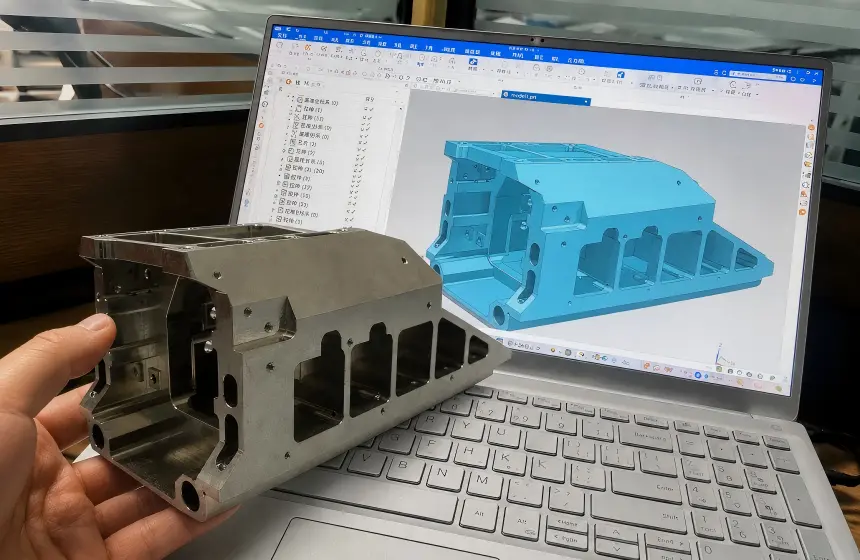
A pocket, hole, or internal feature may be visible in a CAD model but still difficult for a cutting tool to reach.
Deep pockets may require long-reach tools, while narrow internal features may require smaller cutters. Both can increase machining time and make tool deflection or vibration more difficult to control.
Choosing an appropriate machining direction early can often make the design easier to manufacture.
Internal Corners and FeaturesCNC milling cutters are round, so sharp internal corners cannot normally be produced directly with a standard end mill.
Adding practical internal radii can allow larger and more rigid tools to be used. Similarly, unnecessarily small slots, holes, or grooves may require smaller tooling and additional machining time.
DFM therefore connects the geometry of the part with the tools that will actually manufacture it.
TolerancesNot every dimension needs the same level of precision.
Applying unnecessarily tight tolerances to non-critical features can increase machining, inspection, and process-control requirements without improving the function of the part.
A better drawing identifies the dimensions that truly affect assembly, fit, movement, sealing, or other functional requirements.
Workholding and SetupsThe machine must not only reach the feature; the part must also be securely held and accurately referenced.
A design that requires machining from several directions may require additional setups, fixture changes, and datum transfers. Depending on the geometry, 4-axis or 5-axis machining can provide more efficient access to multiple faces and reduce some repositioning requirements. However, the best axis configuration still depends on the actual part, workholding, and feature locations.
DFM Is Closely Connected to the Machining ProcessDFM is not simply a checklist of design rules. The right design also depends on which CNC process is used.
CNC Milling
For milled components, DFM focuses heavily on cutter access, pocket depth, internal radii, wall thickness, and the number of machining setups.
FlexiTurn provides CNC milling for custom non-standard components based on customer drawings, CAD files, or samples. For relatively straightforward geometries, 3-axis machining may be sufficient. More complex parts can be evaluated for 4-axis or 5-axis machining when additional access or different machining orientations are required.
CNC TurningTurning has its own DFM considerations.
Cylindrical parts are generally well suited to CNC turning, but features such as deep bores, narrow grooves, long slender sections, and difficult internal profiles can affect tooling and machining stability.
For parts that combine rotational and milled features, the manufacturing route may involve both turning and milling rather than treating the two processes separately.
FlexiTurn supports custom CNC turning for non-standard turned components and can select the appropriate machining approach according to the part geometry and drawing requirements.
3-Axis, 4-Axis, and 5-Axis MachiningThe number of axes should not be selected simply because more axes sound better.
A simple prismatic component may be efficiently produced on a 3-axis machine. A component with features distributed around several faces may benefit from 4-axis machining. Complex angled surfaces, difficult tool access, or multiple-sided geometries may make 5-axis machining more suitable.
The purpose of DFM is to find the appropriate process for the part rather than automatically choosing the most advanced machine.
Material Choice Is Part of DFMThe same geometry can behave differently depending on the material.
Aluminum, stainless steel, steel, brass, copper, titanium, and engineering plastics all have different machining characteristics. Material hardness, thermal behavior, chip formation, rigidity, and surface requirements can influence tooling and cutting conditions.
This is why material selection should be reviewed together with the geometry and machining process.
FlexiTurn provides custom CNC machining across a range of metals and engineering plastics. For a drawing-based project, material selection can be considered alongside the actual geometry rather than simply choosing a material first and dealing with machining difficulties later.
DFM Can Also Improve Prototyping and Small-Batch ProductionDFM is especially useful before a prototype is manufactured.
A prototype gives engineers an opportunity to test the physical design, but if the first version is difficult to machine, changes to geometry can often be made before the design moves into a larger production run.
FlexiTurn supports rapid prototyping and small-batch production for custom CNC components. Customers can provide drawings, CAD files, or samples, allowing the manufacturing approach to be considered before machining begins.
This is particularly useful for non-standard parts where the design may not have an established manufacturing route.
What Happens During a Practical DFM Review?A useful DFM review does not need to turn into a long engineering report.
The main questions are usually straightforward:
- Can the required features be reached with suitable tooling?
- Are the pockets, holes, walls, and internal radii practical to machine?
- Can the part be held securely?
- How many setups are likely to be required?
- Are the specified tolerances necessary for the function?
- Is the selected material appropriate for the application and machining process?
- How will critical dimensions be inspected?
- Would another machining strategy improve manufacturability?
For a custom CNC project, these questions can be addressed before the part reaches production.
At FlexiTurn, engineering technical support can be involved at the drawing or CAD stage to identify potential manufacturing issues and determine an appropriate machining route. Depending on the component, this may involve CNC milling, CNC turning, 3-axis, 4-axis, or 5-axis machining, followed by applicable surface treatment and dimensional inspection.
DFM Does Not Mean Making the Part Simpler at Any CostA common misunderstanding is that DFM means removing features or making every part easier to machine regardless of its function.
That is not the goal.
If a tight tolerance is necessary for a bearing fit, it should remain. If a deep pocket is required for assembly, it should not simply be made shallower. If a complex surface is essential to the product, the manufacturing process should be selected to produce it correctly.
The goal is to distinguish between features that are functionally necessary and features that create manufacturing difficulty without providing meaningful value.
Why DFM Matters Before You Request a CNC QuoteMany manufacturing problems become more expensive after a design has already been released.
Changing a CAD model before machining is usually much easier than changing finished parts, fixtures, tooling, or production processes afterward.
That is why DFM is valuable not only for manufacturers but also for engineers and procurement teams. It creates a connection between the design intent and the actual machining process, helping control cost, lead time, quality, and production risk.
For custom CNC machining, FlexiTurn works from customer drawings, CAD files, or samples and supports projects from engineering review and rapid prototyping through small-batch production and inspection. Whether the part requires CNC milling, turning, 3-axis, 4-axis, or 5-axis machining, the objective is the same: choose a manufacturing approach that meets the part's actual functional requirements without adding unnecessary machining difficulty.
- Why Do CNC Machining Quotes Differ Between Suppliers?
- How to Prepare a CNC Machining Drawing for Manufacturing?
- How Does Part Geometry Affect CNC Machining Cost?
- Why Are Small Internal Radii Difficult to CNC Machine?
- How Do Deep Pockets Affect CNC Machining?
- Common CNC Machining Design Mistakes That Increase Cost
- How Can DFM Reduce CNC Machining Cost?
- What Is DFM in CNC Machining and Why Does It Matter?