Custom Galvanized Steel Stamping Brackets
Product Overview:
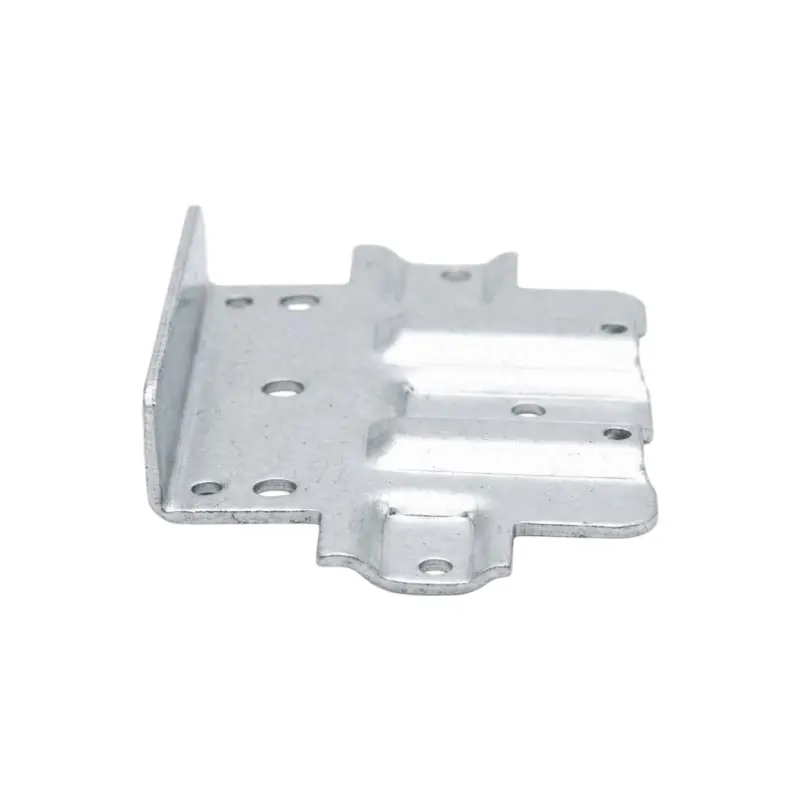
FlexiTurn custom stamps and forms galvanized steel mounting brackets from SGCC/SECC sheet to your 2D/3D CAD data. We manage zinc-coating integrity at bend radii, formed-rib geometry, and hole-to-edge relationships through controlled die clearances and non-contact optical inspection. Prototype to production supported.
Workmanship: Sheet Metal Fabrication
Material: Steel
Inquiry Email: sales@flexiturn.com
Custom Galvanized Steel Stamping Brackets Details
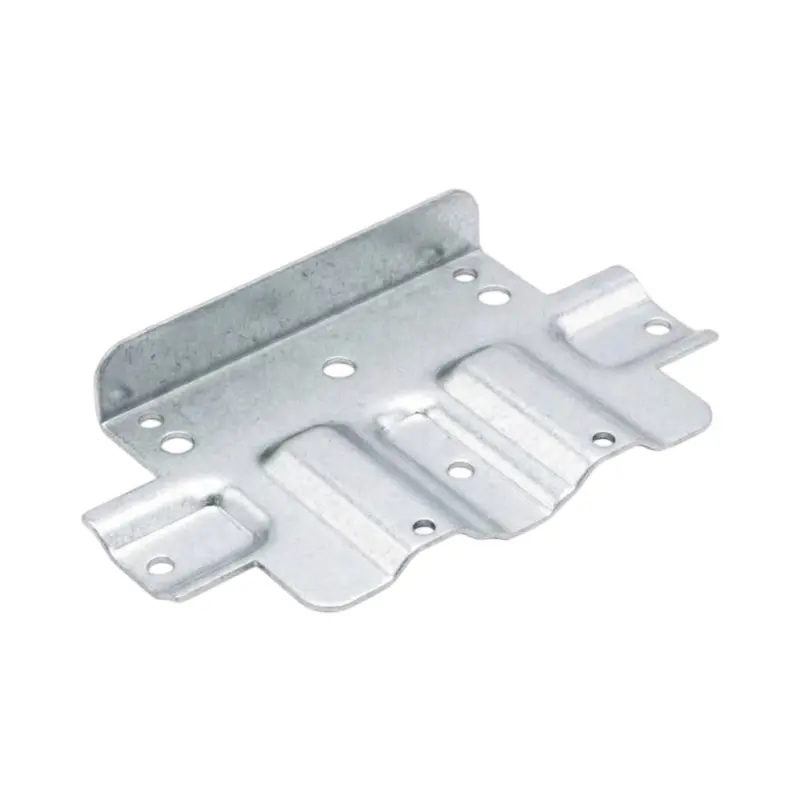
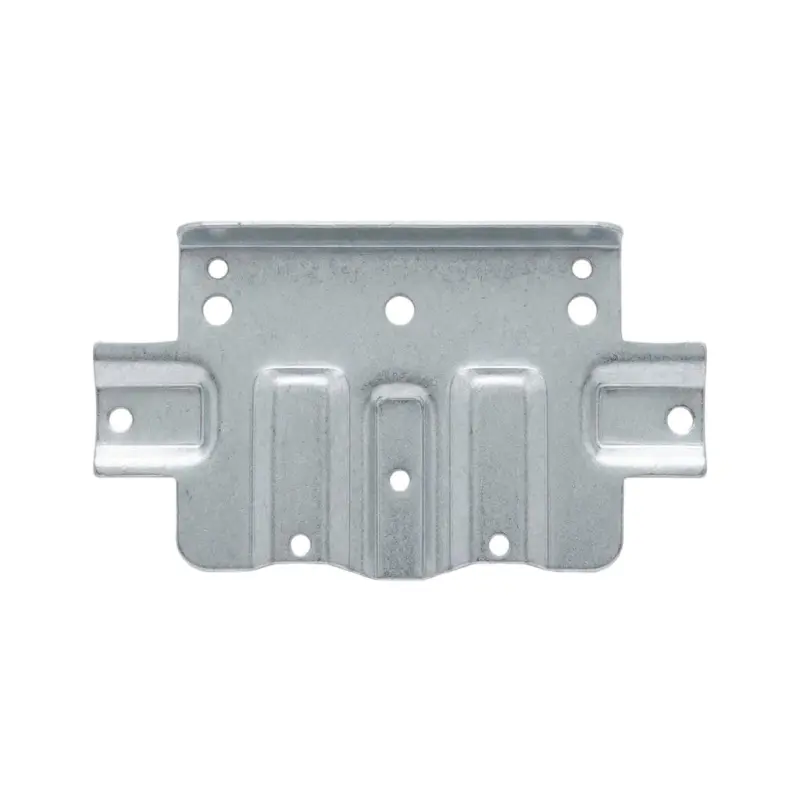
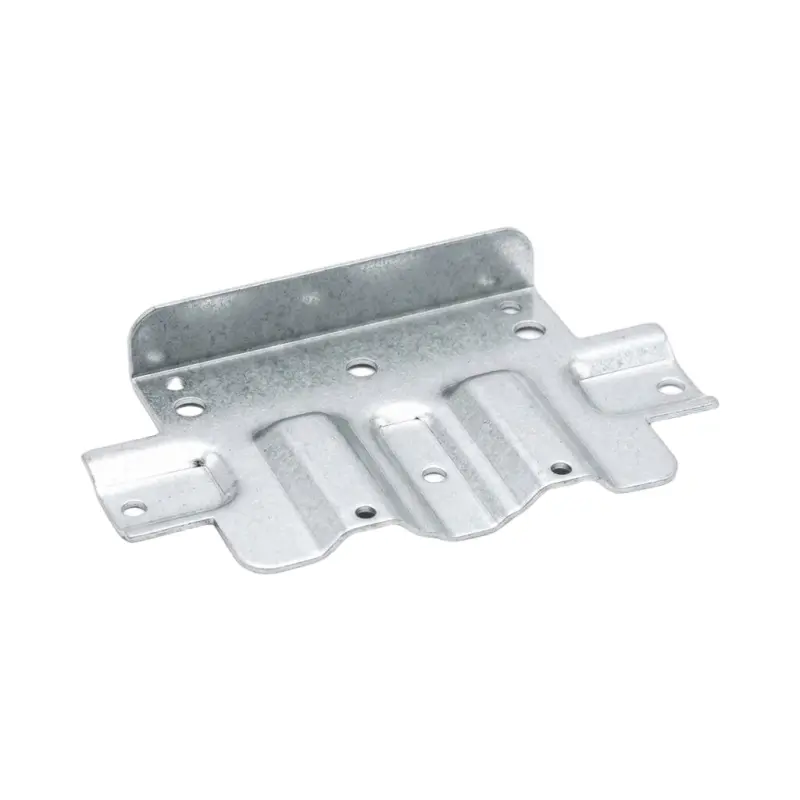
FlexiTurn provides custom sheet metal stamping and forming services for galvanized steel brackets, exemplified by the ribbed mounting bracket shown above. This part features a stepped perimeter, multiple punched mounting holes, a formed flange, and three central stiffening ribs. Every dimension, hole position, and formed feature is defined by your 2D or 3D CAD data.
The service FlexiTurn delivers is the controlled stamping and forming process: converting flat galvanized sheet into a functional structural bracket with defined rib geometry, hole pattern, and coating integrity at formed features.
Forming Galvanized Steel
The central difficulty in this part is not the blanking or the punching — it is preserving the zinc coating through the formed ribs and bend radii. The zinc-iron intermetallic layer on hot-dip galvanized sheet is harder and more brittle than the underlying steel. When forced into a bend radius sized for bare carbon steel, the coating cannot stretch with the core and fractures, leaving micro-cracks or visible flaking that become corrosion initiation sites in service.
FlexiTurn addresses this through forming-specific process controls:
- Bend Radius & Die Optimization: For galvanized material, minimum inside bend radii are increased relative to bare steel practice to keep the coating within its elastic limit.
- Rib Forming with Controlled Strain: Formed stiffening ribs are produced with controlled blank-holder pressure to distribute strain across the feature rather than concentrating it at the rib root.
- Tooling Surface Management: Polished tooling and appropriate lubrication reduce zinc galling (transfer of soft zinc onto die shoulders), which otherwise scratches the part and accelerates die wear.
- Hole-to-Formed-Feature Relationship: Mounting holes are positioned relative to formed datums so that hole distortion from nearby forming does not compromise bolt fit.
Material Selection
FlexiTurn stamps galvanized brackets from sheet grades matched to the corrosion environment:
- SGCC (Hot-Dip Galvanized): Thicker zinc coating, stronger salt-spray resistance. Suitable for outdoor equipment, chassis supports, and brackets exposed to moisture.
- SECC (Electro-Galvanized): Thinner, smoother zinc layer with better surface uniformity and paint adhesion. Suitable for indoor enclosures, electronic chassis, and appearance-critical brackets.
- Thickness range: Typically 0.5 mm to 3.0 mm, depending on structural requirement and bend radius feasibility.
Material certificates with coating weight and heat-number traceability are available upon request.
Tolerances & Quality
Typical stamping and forming capabilities for galvanized brackets:
- General dimensions: ±0.10 mm on formed features; ±0.05 mm on critical hole positions
- Hole diameter: ±0.05 mm, subject to thickness and punch condition
- Bend angle: ±0.5° for standard production; tighter upon engineering review
- Coating integrity: Visual and magnified inspection at bend radii and rib roots for flaking or micro-cracking.
- Inspection note: Thin stamped brackets deflect under contact probing. For this bracket class, FlexiTurn uses non-contact optical or blue-light scanning for first-article and formed-feature verification, avoiding stylus-induced distortion of the part during measurement.
Why Choose FlexiTurn
Galvanized-specific forming knowledge: We treat the zinc coating as an engineering constraint, not an afterthought. Bend radii and rib tooling are set to protect coating integrity.
Rib and flange capability: Controlled forming of stiffening ribs, stepped flanges, and multi-feature brackets.
Inspection matched to part behavior: Non-contact optical scanning for thin, reflective, formed parts.
DFM review before tooling: We check bend-radius-to-thickness ratios, hole-to-form clearance, and rib strain against your drawing before quoting.
Documented traceability: Mill certificates, coating-weight records, and first-article dimensional reports available.
FlexiTurn serves industries including industrial equipment, automation machinery, outdoor enclosures, electronics chassis, and non-safety-critical automotive brackets.
Get Started
Submit your 2D/3D CAD files, specify the galvanized grade (SGCC or SECC), sheet thickness, critical hole tolerances, and surface treatment requirement. FlexiTurn’s engineering team will review your bracket for bend-radius feasibility, rib formability, and coating integrity.
Contact FlexiTurn today to discuss your galvanized steel stamping requirements.
FlexiTurn – Precision Machining, Delivered with Trust.

Q1. What types of machining services do you offer?
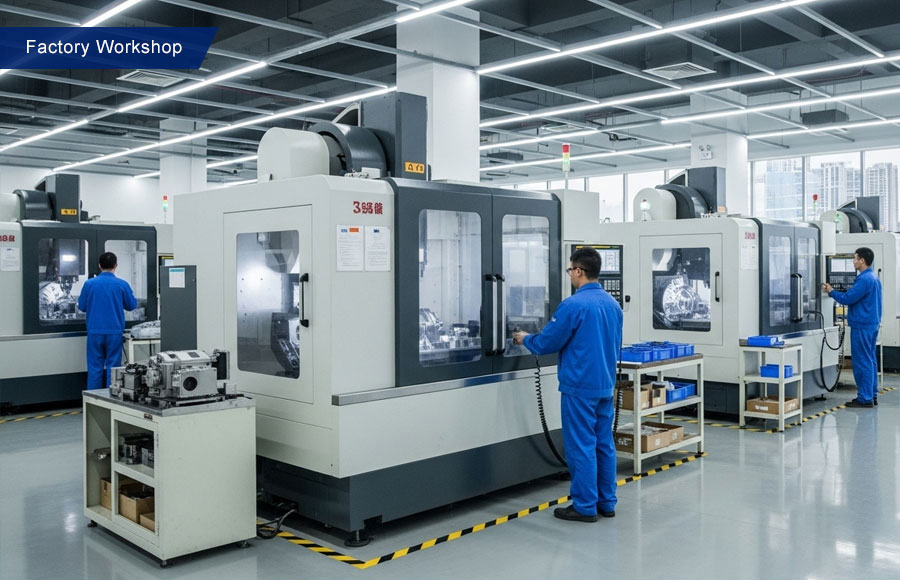
We provide comprehensive CNC turning and milling services. FlexiTurn machines are equipped with 8-station programmable turrets and support both turning and 5-axis milling operations, making them suitable for everything from simple cylindrical parts to complex multi-axis components.
Q2. What materials can you work with?
We machine a wide range of materials including carbon steel, stainless steel, aluminum, plastics, and other engineering-grade materials. If you have a specific material in mind, just send us your requirements and we'll confirm feasibility.
Q3. What is your typical lead time?
Lead times vary depending on part complexity, quantity, and material availability. For prototypes and small-batch runs, we typically deliver within 5–10 business days. For high-volume production, we'll provide a customized schedule after reviewing your drawings. Contact us with your project details for an accurate timeline.
Q4. How do you price your services?
Pricing is based on several factors: material cost, machining time, tooling requirements, setup complexity, and order quantity. We offer competitive rates for both low-volume prototypes and high-volume production runs. Request a quote with your CAD files or drawings and we'll get back to you within 24 hours.
Q5. What quality control measures do you have in place?
We follow strict quality control procedures throughout the machining process. Our CNC systems support programmable precision down to 1 μm, ensuring high accuracy and repeatability. Every batch undergoes dimensional inspection before shipping, and we can provide inspection reports upon request.