
Phone: +86 15398058207
E-mail: sales@flexiturn.com
Add: Room 603 Building C, The Huixin Center, Zhangba One Road, Yanta Zone, Xi'an City, Shaanxi Province, China
Why Are Deep Cavities Difficult to CNC Machine?
Why Are Deep Cavities Difficult to CNC Machine?
At FlexiTurn, we frequently encounter deep cavities when producing custom CNC machined parts such as housings, structural components, manifolds, and industrial equipment parts. These features can be more difficult to machine than shallow pockets because the deeper the cavity becomes, the harder it is to maintain tool rigidity, remove chips, control cutting forces, and achieve consistent dimensions.
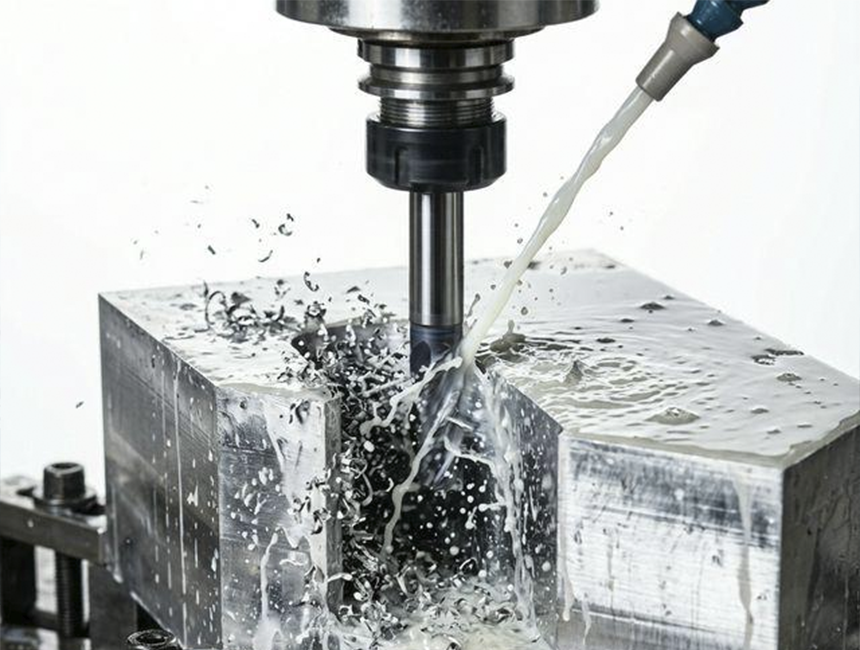
For engineers and purchasing teams, understanding these challenges during the design and quoting stage can help avoid unnecessary machining costs and production problems.
What Is a Deep Cavity in CNC Machining?
A deep cavity is a recessed internal feature where the depth is relatively large compared with its opening width. CNC milling requires the cutting tool to extend deep into the cavity to reach the bottom and internal walls.
The actual difficulty depends on factors such as cavity depth, opening width, tool diameter, material, tolerance, and internal geometry. A narrow cavity that requires a long, slender cutting tool is generally much more challenging than a wider cavity of the same depth.
Why Are Deep Cavities Difficult to Machine?
1. Tool Deflection and Vibration
The deeper the cavity, the longer the cutting tool often needs to be. Long tool overhang reduces rigidity and makes the tool more susceptible to deflection under cutting forces.
Even small amounts of deflection can affect cavity dimensions and wall accuracy. If the tool becomes unstable, vibration or chatter may also occur, leaving visible marks on the machined surface and reducing tool life.
This is particularly important when machining hard materials or when tight dimensional tolerances are required.
2. Difficult Chip Evacuation
Removing chips becomes more difficult as the cavity gets deeper and narrower. Chips can accumulate around the cutting tool instead of leaving the machining area efficiently.
If chips are repeatedly recut, cutting forces and heat can increase, potentially causing excessive tool wear, poor surface finish, or tool breakage.
Effective coolant or air delivery, suitable tool geometry, and an appropriate roughing strategy are therefore important for deep-cavity machining.
3. Limited Tool Access
Deep cavities often contain narrow openings, small internal radii, slots, or other features that restrict tool access.
A small cutting tool may be required to reach these areas, but smaller tools are generally less rigid and more sensitive to vibration. At the same time, using a larger tool may not be possible because of the cavity geometry.
This creates an important design consideration: internal corners should have the largest practical radius whenever the application allows it.
4. Maintaining Surface Finish and Accuracy
Deep cavity walls and bottoms can be more difficult to finish consistently because the cutting tool is operating under less rigid conditions.
When a part requires tight tolerances or a specific surface finish, additional semi-finishing and finishing operations may be necessary. The machining strategy must balance material removal efficiency with cutting stability and dimensional control.
For precision components, inspection is also important. Deep internal features may be difficult to measure with conventional tools, so suitable inspection methods such as CMM measurement may be required for critical dimensions.
What Makes a Deep Cavity More Challenging?
Several design and manufacturing factors can increase machining difficulty:
High depth-to-width ratio: Narrow, deep cavities require greater tool reach and are more prone to deflection.
Hard materials: Materials such as hardened steel and titanium can increase cutting forces and tool wear.
Tight tolerances:Less tolerance for tool deflection, thermal effects, and process variation.
Small internal radii:Smaller radii often require smaller, less rigid cutting tools.
Difficult surface finishes:Additional finishing passes may be needed.
High production volume:Tool life, cycle time, and process stability become more important for repeated production.
How Can Deep-Cavity Machining Be Improved?
The most effective solution is to consider manufacturability before production begins.
Use the Largest Practical Tool
Where the geometry permits, a larger-diameter tool generally provides better rigidity and more efficient material removal. Increasing internal corner radii can also make it possible to use a larger tool.
Minimize Tool Overhang
Tool extension should be kept as short as practical. Excessive overhang increases the risk of deflection and vibration, particularly during finishing operations.
Separate Roughing and Finishing
Deep cavities are often better machined through several stages rather than removing all material with a single tool. Roughing can focus on efficient material removal, followed by semi-finishing and finishing operations for dimensional and surface requirements.
Optimize Toolpaths and Cutting Conditions
Toolpath selection, step-down, step-over, cutting speed, and feed rate should be matched to the material and cavity geometry. Depending on the application, adaptive roughing or other optimized milling strategies can help control cutting forces and improve tool life.
Consider the Cavity During Part Design
A small design adjustment can sometimes make a significant difference. Before production, engineers should consider whether the cavity can be widened, whether internal radii can be increased, and whether extremely tight tolerances or surface-finish requirements are functionally necessary.
How FlexiTurn Approaches Deep-Cavity CNC Machining
At FlexiTurn, deep-cavity machining is planned according to the actual part geometry, material, tolerance, surface-finish requirements, and production volume rather than using the same machining approach for every component.
Our CNC milling capabilities, including 3-axis, 4-axis, and 5-axis machining, provide different options for accessing complex internal features. Tool selection, machining strategy, and finishing operations can be coordinated according to the cavity geometry, while CMM inspection can be used when critical dimensions require verification.
This approach is particularly relevant for custom CNC parts where deep pockets, internal walls, narrow openings, or complex three-dimensional features are part of the design.
Conclusion
Deep cavities are difficult to CNC machine because they combine several challenges: reduced tool rigidity, tool deflection, vibration, chip evacuation, limited tool access, and demanding dimensional or surface-finish requirements.
Good results depend not only on the CNC machine itself, but also on part design, tool selection, tool overhang, machining strategy, cutting conditions, and inspection.
For procurement and engineering teams, reviewing these factors before production can help identify potential machining risks early and avoid unnecessary cost and delays.
- Why Are Deep Cavities Difficult to CNC Machine?
- What Causes Dimensional Variation in CNC Machined Parts?
- CNC Machining Tolerances: What Accuracy Does Your Part Really Need?
- Why Do CNC Machining Quotes Differ Between Suppliers?
- How to Prepare a CNC Machining Drawing for Manufacturing?
- How Does Part Geometry Affect CNC Machining Cost?
- Why Are Small Internal Radii Difficult to CNC Machine?
- How Do Deep Pockets Affect CNC Machining?