
Phone: +86 15398058207
E-mail: sales@flexiturn.com
Add: Room 603 Building C, The Huixin Center, Zhangba One Road, Yanta Zone, Xi'an City, Shaanxi Province, China
Why Do CNC Machining Quotes Differ Between Suppliers?
Why Do CNC Machining Quotes Differ Between Suppliers?
At FlexiTurn, we review CNC machining projects based on customer drawings, CAD files, or samples every day. One situation we frequently encounter is that the same part can receive significantly different quotations from different suppliers.
This does not necessarily mean that one supplier is overcharging or that the lowest quote is the best option. CNC machining costs depend on how the supplier plans to manufacture the part, including material usage, machining time, machine selection, setup, inspection, finishing, and production quantity.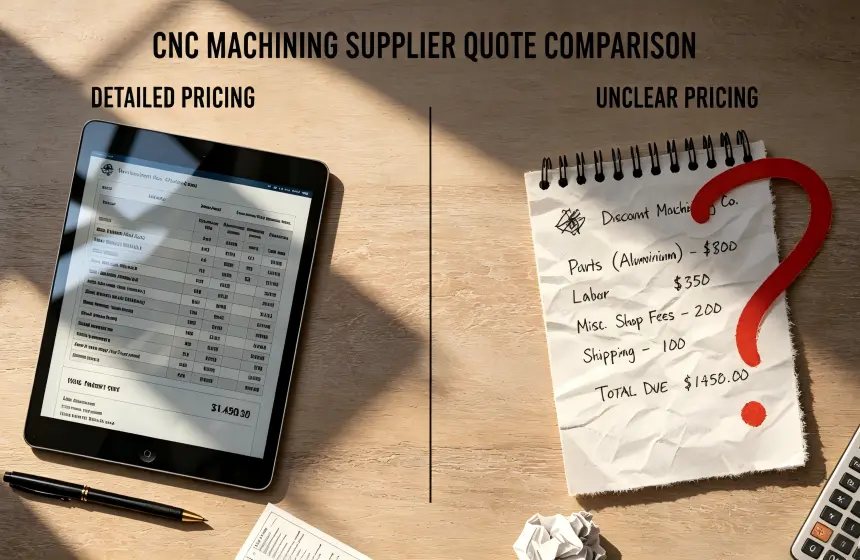
So, why can the same CNC machined part have such different prices?
Material and Stock Size
The material grade is an important part of the quotation, but it is not the only material-related cost.
Different suppliers may choose different starting stock sizes or forms for the same finished component. A block, plate, or bar that is significantly larger than necessary can increase both material waste and machining time.
For this reason, a meaningful quotation should consider not only the specified material grade but also how the supplier plans to source and prepare the starting material.
Machining Time and Process
Machining time is one of the most important factors behind CNC pricing.
Deep pockets, thin walls, complex contours, multiple holes, threads, and difficult-to-reach features can all increase machining time. Different suppliers may also use different machining strategies for the same geometry.
For example, a part may be produced on a 3-axis machine with several setups, while another manufacturing approach may use 4-axis or 5-axis machining to access multiple surfaces more efficiently.
At FlexiTurn, the machining approach is selected according to the actual part geometry and requirements rather than applying the same process to every project.
Setup and Fixturing
CNC machining involves more than the time when the cutting tool is running.
Before production, the supplier may need to prepare workholding, install tooling, set work coordinates, and develop or adjust machining programs. Parts requiring machining on multiple sides may also need several setups.
These costs are particularly noticeable for prototypes and small batches because the preparation cost is distributed across fewer parts. As quantities increase, the same setup and programming costs can be spread across more components.
Tolerances and Inspection
Tolerance requirements can also create significant differences between quotations.
Tight tolerances may require more controlled machining, additional finishing operations, and more frequent measurements. If many features are assigned unnecessarily tight tolerances, the manufacturing cost can increase without providing a practical benefit to the finished component.
Inspection requirements matter as well. Standard dimensional checks may be sufficient for some parts, while more demanding components may require CMM inspection to verify critical dimensions and feature relationships.
When preparing a quotation, clearly identifying functional tolerances and inspection requirements helps suppliers price the job more accurately.
Surface Finishing
Surface treatment is another factor that can make two quotations look different.
Depending on the application, CNC machined parts may require anodizing, polishing, sandblasting, electroplating, or another specified finish. These processes can involve additional preparation, masking, handling, and inspection.
When comparing quotes, check whether the required surface treatment is included. A lower machining price may not represent a lower final cost if finishing is quoted separately.
Production Quantity
Quantity has a direct effect on CNC machining unit cost.
For a small prototype order, programming, setup, tooling, and inspection costs are spread across only a few parts. In larger batches, these fixed costs can be distributed across more units, and the production process can often be optimized for better efficiency.
This is why providing an expected quantity when requesting a quote is important. A supplier quoting one prototype and a supplier quoting 500 production parts may use very different cost assumptions even when the drawing is identical.
Engineering and Manufacturing Strategy
A CNC machining quotation also includes decisions made before the part reaches the machine.
Engineers may need to review the drawing or CAD file, evaluate manufacturability, select suitable tools, determine workholding, and develop an efficient machining strategy.
This becomes especially important for complex geometries, difficult-to-machine materials, prototypes, and parts with multiple critical features.
FlexiTurn provides engineering support during the quotation and production process, helping customers evaluate manufacturability before machining begins. In some cases, a small design or process adjustment can reduce unnecessary machining time or simplify production.
Why the Lowest Quote May Not Be the Best Quote
When comparing suppliers, it is tempting to choose the lowest unit price. However, the quoted price may be based on different assumptions.
One supplier may exclude surface finishing or additional inspection. Another may interpret tolerances differently or use a different starting material. Lead time, packaging, or other production requirements may also be handled differently.
Therefore, the key question is not simply:
“Which supplier is cheapest?”
A better question is:
“What exactly is included in this quotation, and does the proposed manufacturing approach meet my requirements?”
Comparing material, machining process, setup, tolerances, inspection, finishing, quantity, lead time, and additional charges can provide a much clearer picture of the actual cost.
How FlexiTurn Approaches CNC Machining Projects
FlexiTurn focuses on non-standard CNC machining rather than standard catalog parts. Customers can provide drawings, CAD files, or samples, and the manufacturing process is developed around the specific component and its requirements.
Depending on the part, production may involve CNC milling, CNC turning, 3-axis, 4-axis, or 5-axis machining, along with CMM inspection and required surface treatment.
For prototypes and small-batch production, this approach is particularly valuable because decisions made during quotation and engineering review can affect material consumption, machining time, setup requirements, and overall production cost.
As a factory-direct manufacturer, FlexiTurn works with customers to find a practical manufacturing approach rather than simply providing a price based on a standard part category.
Final Thoughts
CNC machining quotes differ because suppliers may make different decisions about material, machining methods, machine selection, setup, inspection, finishing, and production strategy.
A lower quotation is not automatically a better deal, and a higher quotation is not automatically better quality. The most useful comparison is to understand the assumptions behind each quote and whether they match your actual requirements.
Providing complete drawings, CAD files, material specifications, quantities, tolerances, finishing requirements, and inspection expectations can help suppliers provide more accurate and comparable CNC machining quotations.

- Why Do CNC Machining Quotes Differ Between Suppliers?
- How to Prepare a CNC Machining Drawing for Manufacturing?
- How Does Part Geometry Affect CNC Machining Cost?
- Why Are Small Internal Radii Difficult to CNC Machine?
- How Do Deep Pockets Affect CNC Machining?
- Common CNC Machining Design Mistakes That Increase Cost
- How Can DFM Reduce CNC Machining Cost?
- What Is DFM in CNC Machining and Why Does It Matter?