
Phone: +86 15398058207
E-mail: sales@flexiturn.com
Add: Room 603 Building C, The Huixin Center, Zhangba One Road, Yanta Zone, Xi'an City, Shaanxi Province, China
The Best Multi-Axis CNC Machines for Aerospace Manufacturing?
The Best Multi-Axis CNC Machines for Aerospace Manufacturing
Aerospace components often combine complex geometry, difficult-to-machine materials, tight dimensional requirements, and relatively low production volumes. These characteristics make the choice of CNC machining process particularly important.
Multi-axis CNC machining can improve tool access, reduce the number of setups, and help maintain the positional relationship between critical features. However, the best machine configuration depends on the actual aerospace component rather than simply choosing the machine with the highest number of axes.
Why Multi-Axis CNC Machining Matters in Aerospace
Many aerospace components contain angled surfaces, curved profiles, deep pockets, and features distributed across multiple faces.
With conventional 3-axis machining, these features may require several setups. Each additional setup increases handling time and creates another opportunity for positioning errors.
4-axis and 5-axis machining provide additional rotary movement, allowing the cutting tool to approach the workpiece from different directions. This can reduce repositioning and make complex features easier to machine.
5-axis machining is particularly useful for components with complex curved surfaces or features that require continuous changes in tool orientation.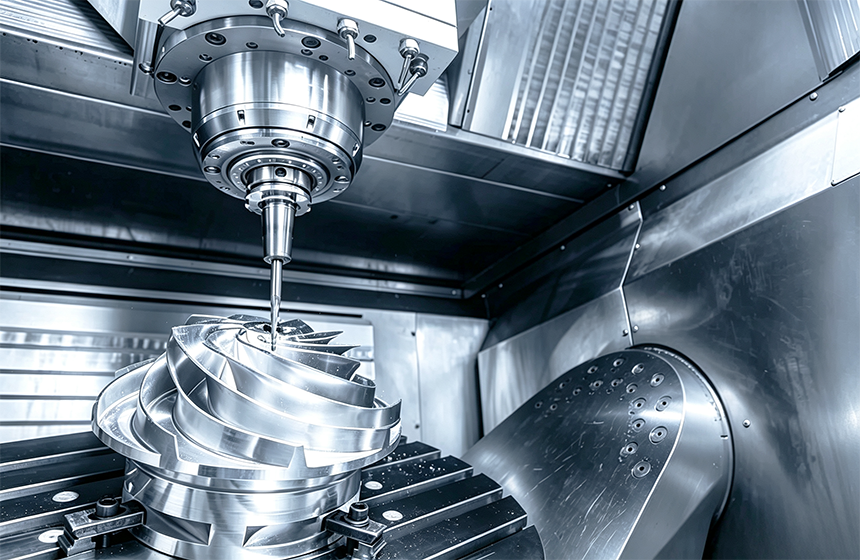
What Should You Look for in an Aerospace CNC Machining Process?
The number of machine axes is only one consideration. Aerospace buyers should first evaluate the actual requirements of the component.
Machine Rigidity and Stability
Materials such as titanium, stainless steel, and nickel-based alloys can generate high cutting forces and heat during machining.
A stable and rigid machining system helps control vibration and maintain dimensional consistency, especially when producing components with deep cavities or demanding tolerances.
Tool Access and Axis Capability
The machining process should provide sufficient access to all required features.
3-axis machining can be effective for relatively simple components, while 4-axis machining can improve access to features distributed around a part.
For highly complex surfaces, deep features, or components requiring machining from several directions, 5-axis machining can provide greater flexibility and reduce the number of setups.
Work Envelope
The machining equipment must also accommodate the size and weight of the component.
Small aerospace brackets and precision components can be produced on compact machining centers, while large structural components require greater machine travel and workholding capacity.
Selecting an appropriate work envelope also makes fixture design and part positioning easier.
Match the Machining Process to the Aerospace Component
Different aerospace components require different approaches.
Turbine Blades
Turbine blades contain complex curved surfaces that are difficult to machine efficiently using conventional 3-axis methods. Multi-axis machining allows the cutting tool to approach these surfaces from changing angles and maintain better tool access.
Structural Brackets
Structural brackets commonly contain pockets, mounting holes, angled surfaces, and features on multiple faces. Depending on the design, 3+2 or 5-axis machining can reduce setups and improve consistency between critical features.
Engine Housings
Engine housings may include internal cavities, precision bores, mounting interfaces, and other difficult-to-access features. The machining process needs sufficient tool access and dimensional stability to produce these features accurately.
Landing Gear Components
Landing gear components can be relatively large and require significant material removal. Machine rigidity, workpiece capacity, and stable cutting conditions are important considerations.
Blisks and Impellers
Blisks and impellers contain highly curved blade structures. Simultaneous 5-axis machining is often advantageous because the cutting tool must approach the surfaces from continuously changing directions.
Aircraft Frames
Large aircraft frames and structural components require sufficient machine travel and workpiece capacity. When machining aluminum structures, efficient material removal and stable dimensional control are also important.
Material Selection Affects Machining
The aerospace material should be considered together with the component geometry.
Aluminum is widely used in aerospace structures because of its low density and machinability. Titanium is valued where high strength-to-weight performance is required but is more demanding to machine because of its cutting characteristics.
Stainless steels and nickel-based alloys can also require carefully controlled cutting conditions.
For this reason, the machining strategy should be selected according to the combination of material, geometry, tolerances, and production requirements.
What Should Aerospace Buyers Evaluate?
When selecting a CNC machining process or supplier, aerospace buyers should consider more than machine specifications.
Important factors include:
- Part geometry and accessibility
- Material and machinability
- Critical dimensional tolerances
- Number of required setups
- Component size and weight
- Prototype or production quantity
- Required inspection
- Expected lead time
A supplier should also be able to review drawings and CAD files and identify potential manufacturing challenges before production begins.
Custom Aerospace CNC Machining at FlexiTurn
FlexiTurn focuses on custom CNC machining rather than standard aerospace components.
Customers can provide drawings, CAD files, or samples, and the machining process can then be selected according to the specific component.
Depending on the geometry and requirements, FlexiTurn can use 3-axis, 4-axis, or 5-axis CNC machining together with CNC milling, CNC turning, and dimensional inspection.
For aerospace prototypes and low-volume production, this flexible approach allows the machining method to change with the component rather than requiring every part to follow the same production process.
Final Thoughts
There is no single "best" multi-axis CNC machine for every aerospace application.
The right choice depends on the component's geometry, material, size, tolerances, production volume, and setup requirements. Simple components may be efficiently produced with 3-axis machining, while more complex parts can benefit from 4-axis or 5-axis machining.
For aerospace manufacturers, selecting the right machining process is ultimately more important than simply choosing the most advanced machine. A process that provides the required tool access, dimensional control, efficiency, and repeatability can deliver better results while keeping prototype and low-volume production practical.
- Why Do CNC Machining Quotes Differ Between Suppliers?
- How to Prepare a CNC Machining Drawing for Manufacturing?
- How Does Part Geometry Affect CNC Machining Cost?
- Why Are Small Internal Radii Difficult to CNC Machine?
- How Do Deep Pockets Affect CNC Machining?
- Common CNC Machining Design Mistakes That Increase Cost
- How Can DFM Reduce CNC Machining Cost?
- What Is DFM in CNC Machining and Why Does It Matter?