
Phone: +86 15398058207
E-mail: sales@flexiturn.com
Add: Room 603 Building C, The Huixin Center, Zhangba One Road, Yanta Zone, Xi'an City, Shaanxi Province, China
How to Choose the Right Multi-Axis CNC Machine for Prototyping?
Choosing the right CNC machining process can directly affect prototype cost, lead time, accuracy, and the number of secondary operations required.
For simple components, 3-axis CNC machining may be sufficient. Parts with multiple angled surfaces, complex contours, deep cavities, or features distributed across several faces may benefit from 4-axis or 5-axis machining.
The right choice depends on the part rather than simply choosing the machine with the most axes.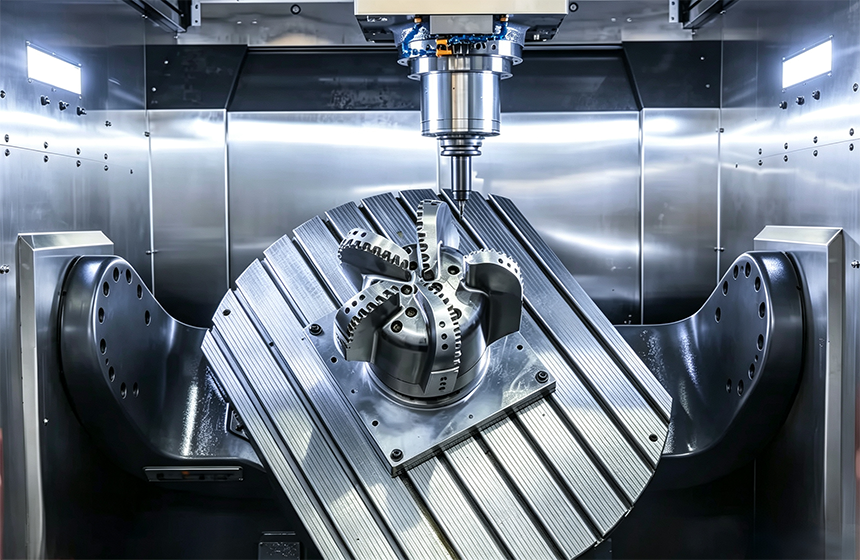
A 3-axis CNC machine moves the cutting tool along the X, Y, and Z axes while the workpiece generally remains fixed. It is suitable for many plates, brackets, housings, and components with accessible features.
4-axis machining adds rotary movement, making it easier to machine features around the sides of a component without manually repositioning the workpiece. It can be useful for housings, shafts, brackets, and parts with radial or multi-face features.
5-axis machining provides additional tool orientation and is particularly useful for complex three-dimensional geometry, angled surfaces, deep features, and components requiring machining from several directions.
The additional axes can reduce setups and improve access to difficult areas, but 5-axis machining is not automatically the best option for every prototype.
Start With Part GeometryPart geometry should be the first consideration when selecting a machining process.
Review the CAD model and ask:
- How many faces contain functional features?
- Are there angled or curved surfaces?
- Are any features difficult to reach?
- Are several features required to maintain a precise relationship?
- How many setups would be required with a conventional process?
A visually simple part can still require multi-axis machining if an internal cavity or angled feature is difficult to access.
When several features need to be machined from different directions, 4-axis or 5-axis machining may reduce repositioning and improve consistency.
Consider Tolerances and MaterialNot every dimension on a prototype needs the same level of precision. Identify critical features such as bearing bores, mounting holes, mating surfaces, and alignment features before selecting the machining process.
Multi-axis machining can help maintain the relationship between these features by reducing the number of setups, but proper workholding, datums, tooling, and inspection remain essential.
Material is another important factor. Aluminum is commonly selected for prototypes because of its machinability and relatively low weight. Stainless steel, alloy steel, titanium, and engineering plastics require different cutting strategies because of their individual machining characteristics.
The material and geometry should therefore be considered together.
Fewer Setups Can Reduce Prototype Lead TimeOne major advantage of multi-axis machining is reducing the number of setups.
With multiple setups, the workpiece must be removed, repositioned, and realigned. This adds preparation time and creates additional opportunities for positioning errors.
A 4-axis or 5-axis process can sometimes machine multiple faces in a single setup, improving feature-to-feature consistency while reducing handling time.
This can be particularly valuable during prototyping, when several design iterations may need to be produced quickly.
Don't Choose 5-Axis Without a ReasonA 5-axis machine is more capable, but that does not mean it is always more economical.
If a component can be produced accurately and efficiently on a 3-axis machine, using 5-axis machining may add unnecessary cost.
A better question is:
What manufacturing problem does the additional axis solve?
If it improves tool access, reduces setups, supports complex surfaces, or improves the relationship between critical features, the additional capability may be worthwhile.
Production quantity can change the most practical machining approach.
For a one-off prototype, programming and setup time can have a relatively large impact on total cost. For small batches, reducing machining and handling time per part can make multi-axis machining more attractive.
The final decision should therefore consider:
- Part geometry
- Material
- Tolerances
- Quantity
- Number of setups
- Required delivery time
- Overall machining cost
Machine capability is only one part of prototype manufacturing.
A capable machining supplier should be able to review CAD files and drawings, identify difficult features, recommend an appropriate machining process, support design iterations, and provide dimensional inspection when required.
FlexiTurn provides custom CNC machining based on customer drawings, CAD files, and samples. Depending on the part geometry and requirements, production can use 3-axis, 4-axis, or 5-axis CNC machining, together with CNC milling, CNC turning, and dimensional inspection.
The goal is not simply to use the most advanced machine, but to select a practical process that delivers the required accuracy, consistency, and efficiency.
Final ThoughtsChoosing the right multi-axis CNC machine starts with understanding the part.
3-axis machining is often sufficient for simple and accessible features. 4-axis machining can be advantageous when features extend around multiple faces, while 5-axis machining is more suitable for complex geometry and difficult tool access.
By evaluating geometry, tolerances, material, quantity, and setup requirements together, engineers can choose a machining process that balances prototype quality, lead time, and cost.
- Why Do CNC Machining Quotes Differ Between Suppliers?
- How to Prepare a CNC Machining Drawing for Manufacturing?
- How Does Part Geometry Affect CNC Machining Cost?
- Why Are Small Internal Radii Difficult to CNC Machine?
- How Do Deep Pockets Affect CNC Machining?
- Common CNC Machining Design Mistakes That Increase Cost
- How Can DFM Reduce CNC Machining Cost?
- What Is DFM in CNC Machining and Why Does It Matter?