
Phone: +86 15398058207
E-mail: sales@flexiturn.com
Add: Room 603 Building C, The Huixin Center, Zhangba One Road, Yanta Zone, Xi'an City, Shaanxi Province, China
How to choose a stainless steel CNC machining service manufacturer?
Why the Choice of Manufacturer Matters for Stainless Steel
Stainless steel is one of the most widely used materials in precision manufacturing - found everywhere from medical instruments and food-processing equipment to aerospace brackets and marine hardware. It offers exceptional corrosion resistance, strength, and hygiene, which is precisely why it is specified for demanding applications.
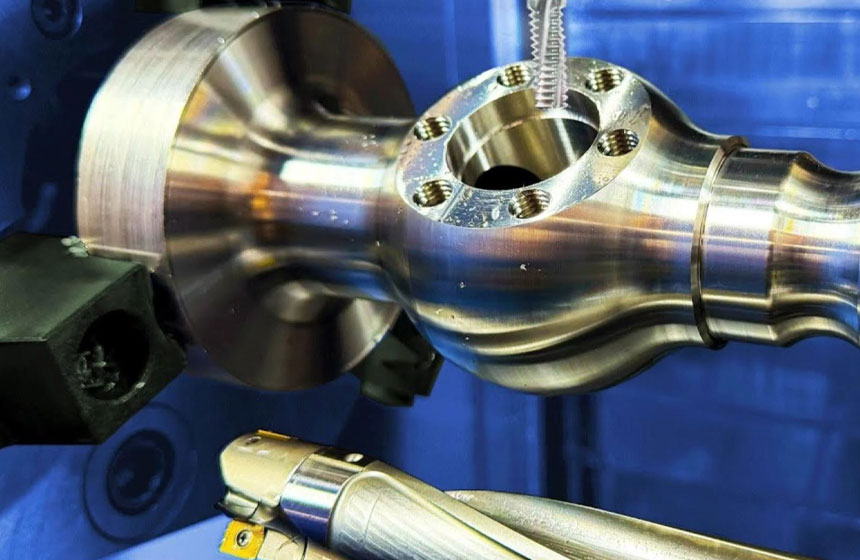
But stainless steel is also one of the trickier materials to machine well. It work-hardens quickly, generates heat, and wears tools aggressively. The difference between a mediocre part and a flawless part is rarely the material - it is the manufacturer's expertise, equipment, and process discipline. Choosing the right stainless steel CNC machining service manufacturer determines your part quality, your lead time, and whether your parts pass inspection the first time - or fail at the worst possible moment.
Step 1: Understand Your Stainless Steel Grade First
Before you can evaluate a manufacturer, you need to know which stainless steel grade your part calls for. Different grades machine very differently, and a manufacturer experienced in 304 may struggle with 17-4 PH - or vice versa.
| Grade | Machinability | Typical Applications |
| 303 | Excellent (free-machining) | Fittings, fasteners, valves, bushings |
| 304 / 304L | Good | Food equipment, enclosures, general parts |
| 316 / 316L | Moderate | Marine, chemical, pharmaceutical, medical |
| 17-4 PH | Moderate (hardens on heat treat) | Aerospace, shafts, high-strength components |
| 416 | Excellent (free-machining) | Pump shafts, fasteners, valve components |
Ask your shortlisted manufacturers which grades they machine most often. A shop that regularly runs 316L and 17-4 PH has the process knowledge - feeds, speeds, tooling, and heat management - to machine your part right the first time.
Step 2: Look for Material-Specific Machining Expertise
Stainless steel is not "just steel." It has three defining machining challenges that separate experienced shops from amateurs:
1. Work hardening. As the tool cuts, the surface hardens. If feeds and speeds are wrong, the tool re-cuts hardened material, causing rapid tool wear and poor surface finish. Experienced shops maintain the right chip load to cut *under* the hardened layer.
2. Heat generation. Stainless conducts heat poorly, so heat concentrates at the cutting edge. Proper coolant delivery - high-pressure through-tool coolant where needed - is essential to protect both tool and part.
3. Built-up edge and chip control. Gummy chips can weld to the tool, degrading finish and dimensions. A capable shop uses appropriate chip breakers and tool geometries.
When evaluating a manufacturer, ask how they handle these three challenges. Vague answers are a red flag; specific process details are a green flag.
Step 3: Check Machine Capability and Rigidity
Machining stainless steel demands rigid machines and adequate spindle power. A lightweight machine will chatter, producing poor surface finish and dimensional drift.
Key capabilities to verify:
- CNC milling with 3-axis, 4-axis, or 5-axis capability for complex geometries;
- CNC turning with live tooling for rotational parts and one-setup finishing;
- Enough spindle power and torque for stainless at production speeds;
- High-pressure coolant systems for deep holes and heat management.
In-house capability matters too. A manufacturer that owns its machines - rather than outsourcing - controls quality, lead time, and cost. Ask for their equipment list and verify it matches your part's needs.
Step 4: Verify Quality Control and Inspection
For stainless steel parts - especially in medical, aerospace, or food applications - inspection is non-negotiable. Your manufacturer should provide:
- ISO 9001:2015 certification as a baseline, with ISO 13485 (medical) or AS9100 (aerospace) where your industry demands it;
- First Article Inspection (FAI) on new parts;
- CMM (Coordinate Measuring Machine) inspection for dimensional verification, especially on tight-tolerance features;
- Material traceability with certificates of conformity from certified mills - critical for medical and aerospace;
- Documented reports shipped with every order, so you have evidence, not promises.
If a shop hesitates to share inspection data on a sample part, that tells you everything you need to know.
Step 5: Evaluate Surface Finishing and Secondary Operations
Stainless parts rarely ship raw. The right manufacturer offers finishing that protects your part and enhances its function:
- Passivation - removes free iron and restores corrosion resistance;
- Electropolishing - smooths micro-surfaces for hygiene, cleanliness, and corrosion resistance;
- Bead blasting - matte, uniform cosmetic finish;
- Mechanical polishing - mirror finish for visible or hygienic parts.
Ask whether these are performed in-house or by vetted partners, and whether finishing is included in your quote or itemized separately. Transparency here prevents invoice surprises.
Step 6: Assess DFM Support and Engineering Communication
The best stainless steel CNC machining service manufacturer challenges your design to make it better and cheaper - before you pay for mistakes. Look for:
- Design-for-manufacturability (DFM) feedback on tolerances, wall thickness, internal corners, and thread specifications;
- Engineer-to-engineer communication - you should talk to a machining engineer, not just a salesperson;
- Written confirmation of every specification before production begins;
- Responsive communication across time zones, with proactive status updates.
Sourcing is a partnership, not a transaction. Choose a manufacturer that acts like an engineering partner.
Step 7: Compare Lead Times and Pricing Transparency
Two more practical checks:
- Lead time. Standard stainless prototypes typically take 3–7 days; production runs scale with volume. Confirm the manufacturer's typical lead time matches your schedule.
- Pricing transparency. A reputable manufacturer gives itemized quotes - material, machining, finishing, and setup - and honors them. Beware of quotes that are mysteriously low, then grow with "surprise" line items.
A great price on a part that fails inspection is the most expensive option of all.
Why Choose FlexiTurn for Stainless Steel Machining
FlexiTurn is a precision CNC machining services provider with deep experience across the full stainless steel family. Here's what you get:
- Material expertise. We machine 303, 304/304L, 316/316L, 17-4 PH, and more every week, with process parameters tuned per grade;
- Modern, rigid equipment. 3-axis, 4-axis, and 5-axis CNC milling and turning with high-pressure coolant;
- Documented quality. ISO 9001-compliant processes, FAI, CMM inspection, and full material traceability;
- Finishing under control. Passivation, electropolishing, bead blasting, and polishing in-house or via vetted partners;
- Instant quoting and DFM feedback. Upload your model and get an itemized quote with manufacturability suggestions in minutes;
- Engineer-to-engineer support. Talk directly with engineers who understand stainless steel's quirks.
From a single medical prototype to 10,000 production components, FlexiTurn delivers stainless steel parts machined right, inspected thoroughly, and delivered on time.
Frequently Asked Questions
What is the easiest stainless steel grade to machine?
303 and 416 are the free-machining grades, offering the best machinability. For maximum corrosion resistance in demanding environments, 316L is the standard choice.
Can stainless steel be machined to tight tolerances?
Yes. FlexiTurn routinely holds ±0.05 mm standard and ±0.01 mm on critical features, verified by CMM inspection.
Do I need passivation after machining?
For parts exposed to corrosive environments or requiring hygienic surfaces, passivation is strongly recommended to restore the corrosion-resistant oxide layer removed during machining.
How do you prevent work hardening during machining?
By maintaining proper chip loads, using sharp tooling, and delivering effective coolant - the process discipline that comes from machining stainless daily.
Can FlexiTurn machine both prototypes and production runs in stainless?
Yes, with no minimum order quantity. Start with a prototype to validate, then scale to full production.
What industries do you serve with stainless steel parts?
Medical devices, food and beverage equipment, marine hardware, chemical processing, and aerospace, among others.
Start Your Stainless Steel Project Today
Choosing the right stainless steel CNC machining service manufacturer is the difference between a part that works and a part that fails. Upload your design to FlexiTurn today and get an instant quote - or talk directly with our engineers about your stainless steel project.
- Why Do CNC Machining Quotes Differ Between Suppliers?
- How to Prepare a CNC Machining Drawing for Manufacturing?
- How Does Part Geometry Affect CNC Machining Cost?
- Why Are Small Internal Radii Difficult to CNC Machine?
- How Do Deep Pockets Affect CNC Machining?
- Common CNC Machining Design Mistakes That Increase Cost
- How Can DFM Reduce CNC Machining Cost?
- What Is DFM in CNC Machining and Why Does It Matter?