
Phone: +86 15398058207
E-mail: sales@flexiturn.com
Add: Room 603 Building C, The Huixin Center, Zhangba One Road, Yanta Zone, Xi'an City, Shaanxi Province, China
How Do Deep Pockets Affect CNC Machining?
Deep pockets are common in CNC machined housings, brackets, fixtures, mechanical components, and structural parts. Although a deep cavity may look simple in a CAD model, machining it can be considerably more demanding than machining a shallow pocket.
The main challenges come from tool reach, tool rigidity, chip removal, machining access, and surface quality. These factors can increase machining time and affect production cost, especially when the pocket is narrow or surrounded by complex geometry.
For customers sourcing custom CNC machined parts, understanding these limitations can help avoid designs that are unnecessarily difficult to manufacture.
Why Does Pocket Depth Matter?The deeper a pocket becomes, the farther the cutting tool must extend from the tool holder.
A short, large-diameter cutter is generally more rigid. When a long-reach tool is required, its resistance to deflection and vibration decreases. This can make it more difficult to maintain stable cutting and consistent wall dimensions.
The problem becomes even more noticeable when a deep pocket also has a narrow opening or small internal radii. A large cutter may not be able to enter the cavity, forcing the use of a smaller tool with greater reach.
This creates a typical machining trade-off:
Deeper pocket + smaller tool + longer reach = greater machining difficulty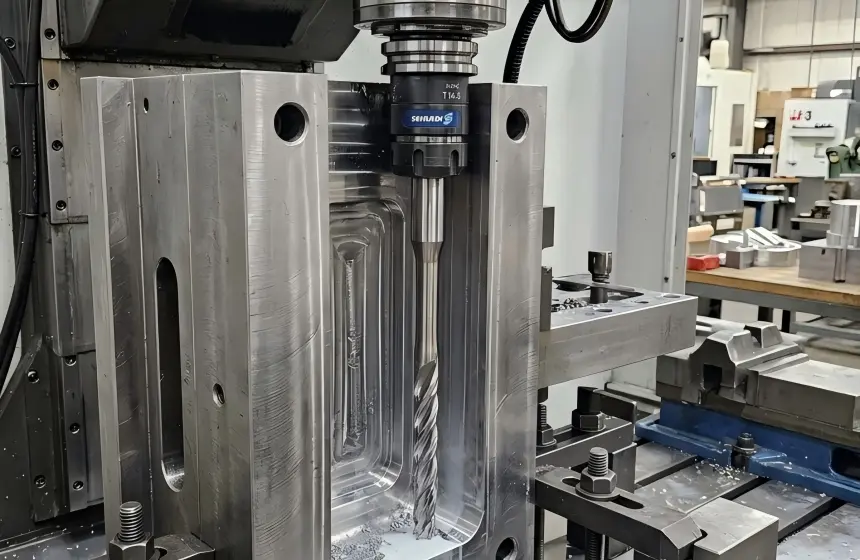
Tool Deflection and Vibration
A long cutting tool can deflect under cutting forces. Excessive deflection may affect wall dimensions and surface finish.
Reducing cutting conditions can improve stability, but this usually increases machining time.
Chip RemovalChips have less space to escape from a deep cavity. If chips accumulate around the cutting area, they can interfere with cutting, increase heat, and accelerate tool wear.
Effective coolant and chip evacuation therefore become more important as pocket depth increases.
Longer Machining TimeDeep pockets often require longer-reach tools, multiple cutting operations, and additional finishing passes.
If the cavity contains different depths, small radii, or complex surfaces, programming and tool changes can further increase cycle time.
Tool AccessibilityThe machine must be able to position the cutter at the required angle and reach the entire feature without interference.
This is where part geometry becomes particularly important.
Deep Pockets Are Not All Equally DifficultThere is no single depth that makes every CNC pocket “too deep.”
A wide cavity with good tool access may be easier to machine than a much shallower but narrow cavity.
For example, a deep pocket with generous internal radii may allow the use of a relatively rigid cutter. A narrow cavity with small internal corners may require a much smaller tool, even if the overall depth is similar.
Material also matters. Aluminum, stainless steel, alloy steel, titanium, and engineering plastics can require different cutting conditions and tooling strategies.
For this reason, pocket depth needs to be considered together with opening size, tool diameter, internal radius, material, wall thickness, and accessibility.
How Multi-Axis CNC Machining Can HelpFor relatively straightforward pockets, 3-axis CNC milling may be sufficient.
More complicated components can benefit from 4-axis or 5-axis machining when different tool orientations are required.
FlexiTurn provides 3-axis, 4-axis, and 5-axis CNC machining, allowing complex non-standard components to be manufactured from different directions when the geometry requires it.
For example, a multi-sided housing may contain deep cavities or difficult-to-reach surfaces that cannot be approached efficiently from a single orientation. Multi-axis machining can provide additional access and reduce the need for repeated setups.
This does not eliminate the limitations of cutting tools, but it can provide more practical options for complex part geometries.
How the Part Design Can Be ImprovedIf a deep pocket is not strictly required, reducing its depth can make machining easier.
If the depth is functionally necessary, designers can consider:
Wider openings
A larger opening may allow a larger and more rigid cutter to enter the cavity.
Larger internal radii
A practical radius can reduce the need for extremely small cutting tools.
Adequate wall thickness
Very thin walls surrounding a deep cavity can become less stable during machining.
Accessible geometry
Changing the orientation or opening of a feature may make it easier for the cutting tool to reach the required surfaces.
These changes can improve machining efficiency without necessarily changing the function of the component.
From Prototype to Small-Batch ProductionDeep-pocket components are often found in custom housings, robotic components, automation equipment, fixtures, and other non-standard mechanical parts.
FlexiTurn manufactures these components according to customer drawings, CAD files, or samples, rather than supplying standard catalog parts.
For prototype projects, CNC machining allows the design to be physically tested before larger production runs. For small-batch production, selecting an appropriate machining strategy can help control cycle time, tooling requirements, and production cost.
FlexiTurn's CNC milling, CNC turning, and 3-axis, 4-axis, and 5-axis machining capabilities provide different manufacturing options depending on the structure of the part.
For projects with difficult cavities, engineering technical support can also help identify potential manufacturing issues during the quotation and DFM stage.
Quality Matters After the Pocket Is MachinedMachining a deep pocket is not only about reaching the bottom of the cavity.
The finished component may also need consistent dimensions, accurate wall locations, and the required surface condition.
FlexiTurn provides CMM inspection for applicable custom CNC machining projects, helping verify critical dimensions after machining. Surface treatment can also be provided when required by the finished component.
This is particularly useful when deep cavities are part of a housing or mechanical assembly where dimensional consistency affects how other components fit together.
When Should You Ask Your CNC Supplier?If a part contains a combination of:
- Deep or narrow pockets
- Small internal radii
- Thin surrounding walls
- Difficult tool access
- Complex multi-sided geometry
it is worth discussing the design before production.
At FlexiTurn, customers can send a drawing, CAD file, or sample for custom CNC machining. Based on the actual component, our team can determine whether standard 3-axis milling is appropriate or whether 4-axis or 5-axis machining would provide a better approach.
This is especially valuable for rapid prototypes and small-batch production, where solving machining problems before production can save both time and cost.
Final TakeawayDeep pockets can affect CNC machining through tool deflection, vibration, chip evacuation, tool accessibility, machining time, and overall cost.
The depth itself is only part of the equation. Opening size, internal radius, material, wall thickness, and machining orientation can all determine how difficult a cavity is to produce.
For custom components, a manufacturable design and the right machining strategy are just as important as the final dimensions.
With CNC milling, turning, 3-axis, 4-axis, and 5-axis machining, together with engineering support, rapid prototyping, small-batch production, and CMM inspection, FlexiTurn can manufacture custom non-standard components according to customer drawings, CAD files, or samples.
If your part contains deep pockets or other difficult features, send your drawing or CAD file to FlexiTurn for a machining review and quotation.
- Why Do CNC Machining Quotes Differ Between Suppliers?
- How to Prepare a CNC Machining Drawing for Manufacturing?
- How Does Part Geometry Affect CNC Machining Cost?
- Why Are Small Internal Radii Difficult to CNC Machine?
- How Do Deep Pockets Affect CNC Machining?
- Common CNC Machining Design Mistakes That Increase Cost
- How Can DFM Reduce CNC Machining Cost?
- What Is DFM in CNC Machining and Why Does It Matter?