
Phone: +86 15398058207
E-mail: sales@flexiturn.com
Add: Room 603 Building C, The Huixin Center, Zhangba One Road, Yanta Zone, Xi'an City, Shaanxi Province, China
Where to order high precision special shaped CNC parts online?
Where to Order High Precision Special Shaped CNC Parts Online?
Ordering CNC machined parts online is relatively straightforward when the component has a simple shape. But when a part contains unusual contours, angled surfaces, deep cavities, multiple machining faces, or other non-standard features, finding the right supplier becomes much more important.
For high-precision special shaped parts, the supplier needs to understand more than the drawing itself. They need to determine how the geometry can be held, accessed, machined, inspected, and reproduced consistently.
So, where should you order these parts online, and what should you look for before placing an order?
Start With the Part, Not the Supplier
Before comparing CNC suppliers, take a close look at the part you need to manufacture.
A special shaped CNC part may include:
- Complex 3D contours
- Irregular external profiles
- Angled or curved surfaces
- Deep or narrow cavities
- Multiple intersecting features
- Precise holes or mounting interfaces
- Tight relationships between different features
These characteristics can make the machining process considerably different from producing a conventional bracket, plate, or shaft.
A supplier that mainly produces simple CNC components may not be the best choice for a highly customized part, even if they offer CNC machining as a standard service.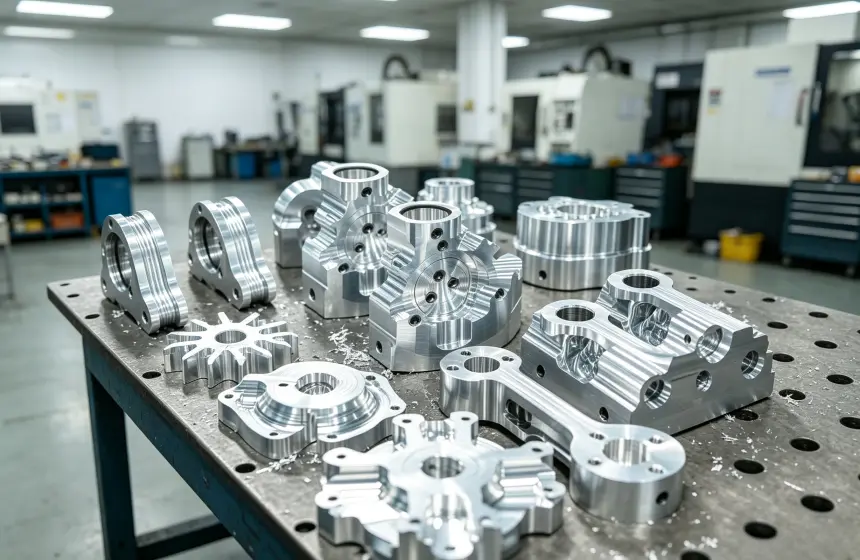
What Should an Online CNC Supplier Be Able to Do?
When ordering a complex part online, the first thing to check is whether the supplier can work directly from your manufacturing information.
A suitable supplier should be able to review 2D drawings, 3D CAD files, or physical samples and understand the functional requirements of the component.
This matters because complex geometry often creates manufacturing questions before machining begins.
For example:
- Can the cutting tool reach the required surfaces?
- Will the part require multiple setups?
- Is 5-axis machining beneficial?
- Where should the workpiece be clamped?
- Which dimensions are critical?
- How should difficult features be inspected?
A good supplier should address these questions during engineering review rather than simply accepting the file and starting production.
Look at Multi-Axis Capability
Special shaped parts often benefit from additional machining axes.
3-axis machining can be effective when the geometry is relatively accessible. When features extend around multiple faces, 4-axis machining may reduce repositioning.
For more complicated contours, angled surfaces, and difficult-to-access features, 5-axis machining can provide greater flexibility.
The goal is not necessarily to use 5-axis machining for every special shaped component. Instead, the machining strategy should be selected according to the actual geometry.
This can affect both part quality and production cost.
Precision Depends on More Than the CNC Machine
High precision is not created by the machine alone.
Workholding, tool selection, programming, cutting conditions, setup accuracy, and inspection all influence the final result.
This becomes especially important when a special shaped part contains several features that must maintain a precise positional relationship.
For example, a housing may have a complex exterior but only a few truly critical dimensions, such as a bearing bore, mounting hole pattern, or mating surface.
The supplier should understand which features are functionally important and control the manufacturing process accordingly.
Material Should Be Part of the Discussion
The material can also affect how a special shaped component should be machined.
Aluminum is often suitable for complex prototypes because it is relatively easy to machine and can support detailed features.
Stainless steel and alloy steel may require more attention to cutting forces and tool wear.
Titanium can be more demanding because of heat generation and its machining characteristics.
Engineering plastics require another approach because excessive heat or cutting force can cause deformation.
Therefore, when requesting an online quotation, providing the exact material grade along with the drawing can help the supplier evaluate the manufacturing requirements more accurately.
Don't Compare Suppliers by Price Alone
Price is important, but it should not be the only factor when purchasing high-precision custom parts.
A very low quotation may not reflect the actual manufacturing process required by a complex component.
When comparing suppliers, consider:
Engineering review
Can the supplier identify difficult features and suggest practical manufacturing methods?
Customization
Can they manufacture directly from your drawings, CAD files, or samples rather than offering only predefined parts?
Machining capability
Can they select between 3-axis, 4-axis, 5-axis milling, or turning according to the component?
Inspection
Can critical dimensions be measured and verified before shipment?
Production flexibility
Can they support a single prototype, a small batch, and subsequent repeat orders?
These factors are often more useful indicators of supplier suitability than a long list of machine specifications.
Where Does FlexiTurn Fit?
FlexiTurn provides custom CNC machining for customers who need parts manufactured according to their own designs.
Instead of selecting a standard component from a catalog, customers can submit **drawings, CAD files, or samples** for customized production.
For special shaped components, the manufacturing process is determined by the part's geometry and requirements. Depending on the design, this may involve CNC milling, CNC turning, 3-axis, 4-axis, or 5-axis machining.
This approach is particularly useful when a component is still in the prototype or development stage and the design may need to be adjusted before moving into repeat production.
From Online Quote to Finished Part
A practical online CNC purchasing process should be simple for the buyer.
Typically, the process starts with submitting the part drawing or CAD model and specifying the material, quantity, tolerances, and finishing requirements.
The supplier can then review the design, evaluate manufacturability, determine the appropriate machining method, and provide a quotation.
After the production details are confirmed, the part can move into machining, inspection, and delivery.
For complex parts, the engineering review between quotation and production is particularly important. It provides an opportunity to identify potential machining problems before they become production problems.
When Is an Overseas CNC Supplier Worth Considering?
For companies sourcing custom components internationally, an overseas CNC supplier can provide access to broader manufacturing capacity and competitive production costs.
However, communication and engineering support become more important.
A reliable supplier should be able to communicate clearly about drawings, material specifications, tolerances, production quantities, and inspection requirements.
For prototypes and low-volume orders, the ability to respond quickly to design changes can also be valuable.
Final Takeaway
The best place to order high-precision special shaped CNC parts online is not simply the supplier offering the lowest quotation. Look for a manufacturer that can understand your design, evaluate complex geometry, select an appropriate machining process, and maintain quality throughout production.
For custom prototypes and low-volume special shaped components, FlexiTurn provides a direct manufacturing route from customer drawings, CAD files, or samples to finished CNC machined parts.
- Why Do CNC Machining Quotes Differ Between Suppliers?
- How to Prepare a CNC Machining Drawing for Manufacturing?
- How Does Part Geometry Affect CNC Machining Cost?
- Why Are Small Internal Radii Difficult to CNC Machine?
- How Do Deep Pockets Affect CNC Machining?
- Common CNC Machining Design Mistakes That Increase Cost
- How Can DFM Reduce CNC Machining Cost?
- What Is DFM in CNC Machining and Why Does It Matter?