
Phone: +86 15398058207
E-mail: sales@flexiturn.com
Add: Room 603 Building C, The Huixin Center, Zhangba One Road, Yanta Zone, Xi'an City, Shaanxi Province, China
CNC Machining Process: From CAD Design to Finished Parts
CNC Machining Process: From CAD Design to Finished Parts
Introduction
CNC machining is a complete manufacturing process that involves more than just operating a machine tool. From the initial digital design to the final finished component, each stage plays an important role in achieving the required dimensions, tolerances, and surface quality.
The CNC machining workflow connects engineering design, computer programming, machining operations, and quality inspection to transform a digital model into a physical part.
This article explains the main stages of the CNC machining process, from CAD design to finished parts.
Step 1: CAD Design and Part Preparation
The CNC machining process begins with creating a digital model of the component using CAD (Computer-Aided Design) software.
The CAD model defines the geometry, dimensions, tolerances, and technical requirements of the part. It provides the necessary information for engineers and manufacturers to plan the machining process.
Common CAD file formats used in CNC machining include STEP and IGES, which allow manufacturing teams to accurately interpret the design before production begins.
Step 2: Design Review and Manufacturing Planning
Before machining starts, the design is reviewed from a manufacturing perspective.
This process is often known as Design for Manufacturing (DFM). The purpose of DFM is to identify potential manufacturing challenges and ensure the part can be produced efficiently.
During this stage, engineers evaluate factors such as part geometry, machining accessibility, material selection, required tolerances, and suitable manufacturing methods.
A well-prepared design helps reduce unnecessary operations and improves production reliability.
Step 3: CAM Programming and Toolpath Generation
After the CAD model is approved, it is imported into CAM (Computer-Aided Manufacturing) software.
CAM software converts the digital design into machining instructions by creating toolpaths and defining machining parameters. These parameters determine how the CNC machine will remove material from the workpiece.
The generated program includes instructions such as tool movement, cutting sequence, and machine operations. These instructions are commonly converted into G-code and M-code, which control CNC machine movements and functions during machining.
Step 4: CNC Machine Setup
Before machining begins, the CNC machine must be properly prepared.
The setup process includes selecting cutting tools, securing the workpiece, setting machine coordinates, and loading the CNC program.
Workholding is especially important because the workpiece must remain stable during cutting operations. Proper setup helps maintain machining accuracy and ensures consistent results.
Step 5: CNC Machining Operation
Once the machine setup is complete, the CNC program is executed and the machining process begins.
The CNC controller interprets the programmed instructions and controls the movement of cutting tools and machine components. Material is gradually removed from the workpiece until the required shape and dimensions are achieved.
Depending on the design requirements, manufacturers may use different machining methods, including CNC milling, CNC turning, drilling, and multi-axis machining.
The selected process depends on factors such as part geometry, material properties, tolerance requirements, and production volume.
Step 6: Quality Inspection and Verification
After machining is completed, the finished part is inspected to confirm that it meets the required specifications.
Inspection typically involves checking:
- Dimensions
- Tolerances
- Surface quality
- Geometric accuracy
For complex components, advanced inspection equipment such as coordinate measuring machines (CMM) may be used to verify critical features.
Quality inspection ensures that the finished part matches the original design requirements before delivery or further processing.
Step 7: Surface Finishing and Secondary Processes
Depending on the application, CNC machined parts may require additional finishing processes after machining.
Surface treatments can improve appearance, corrosion resistance, wear resistance, and overall surface performance.
Common finishing processes include anodizing, powder coating, electroplating, polishing, brushing, and sandblasting.
Additional operations such as marking, assembly, or other secondary processes may also be performed based on customer requirements.
From CAD Design to Finished CNC Parts
The CNC machining process is a complete workflow that combines digital design, engineering planning, automated machining, and quality control.
A CAD model provides the foundation for the part design, CAM software translates the design into machining instructions, CNC equipment performs the material removal process, and inspection verifies the final result.
Through the cooperation of these stages, manufacturers can transform digital concepts into accurate and functional components.
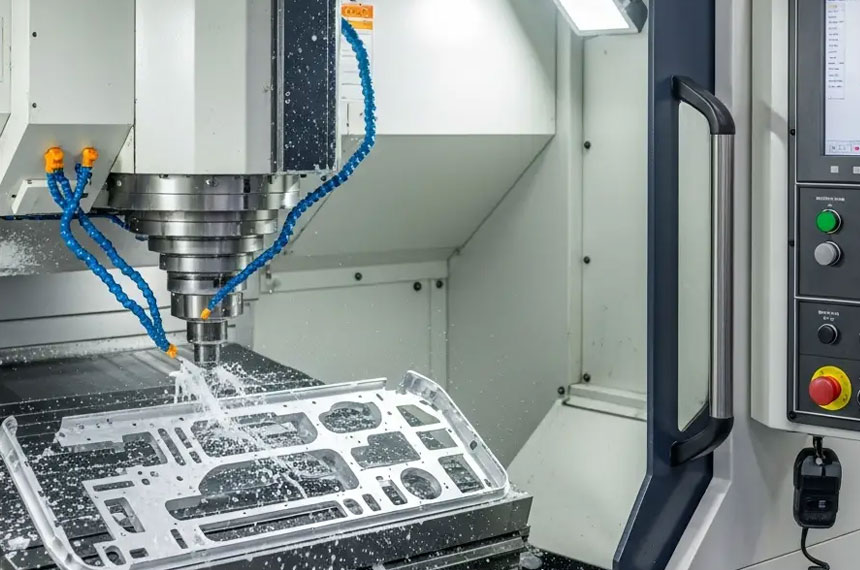
CNC Machining Process at FlexiTurn
FlexiTurn provides CNC machining services covering the complete manufacturing process from design support to finished components.
With CNC milling, CNC turning, and multi-axis machining capabilities, FlexiTurn manufactures custom parts using various metals and engineering plastics.
The company supports customers with engineering review, machining, surface treatment, and quality inspection to meet different manufacturing requirements.
FlexiTurn also supplies precision machining blanks, including pre-machined semi-finished blanks in different shapes and materials for CNC manufacturing applications.
Conclusion
The CNC machining process involves multiple stages, from CAD design and CAM programming to machining, inspection, and finishing.
Each step contributes to the accuracy, quality, and reliability of the final component.
By understanding the complete CNC machining workflow, engineers and manufacturers can better plan projects and select suitable manufacturing methods for their parts.
- Why Do CNC Machining Quotes Differ Between Suppliers?
- How to Prepare a CNC Machining Drawing for Manufacturing?
- How Does Part Geometry Affect CNC Machining Cost?
- Why Are Small Internal Radii Difficult to CNC Machine?
- How Do Deep Pockets Affect CNC Machining?
- Common CNC Machining Design Mistakes That Increase Cost
- How Can DFM Reduce CNC Machining Cost?
- What Is DFM in CNC Machining and Why Does It Matter?