
WeChat: 15398058207
Phone: +86 15398058207
E-mail: sales@flexiturn.com
Add: Room 603 Building C, The Huixin Center, Zhangba One Road, Yanta Zone, Xi'an City, Shaanxi Province, China
Phone: +86 15398058207
E-mail: sales@flexiturn.com
Add: Room 603 Building C, The Huixin Center, Zhangba One Road, Yanta Zone, Xi'an City, Shaanxi Province, China
Brass Copper Bronze in CNC Machining Differences and Selection Guide
Time: 2026-08-26 Source: CNC Machining Manufacturer Author: Claire
Brass vs. Copper vs. Bronze in CNC Machining Differences and Selection Guide
Although all three are copper-based materials, their compositions, mechanical properties, and machinability differ significantly. Choosing the right one depends on your application's priorities—conductivity, strength, corrosion resistance, cost, or ease of manufacturing.
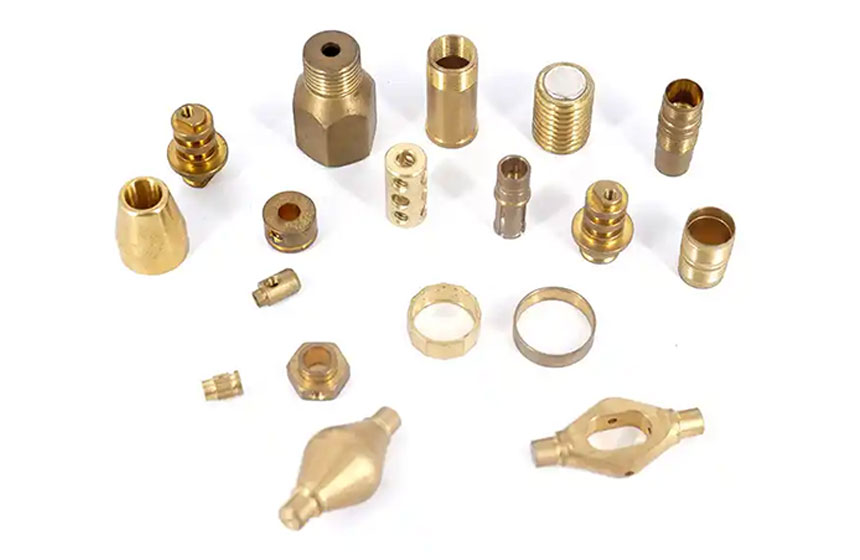
1. Material Composition & Core Characteristics
Copper (Pure Copper)
- Composition: ≥99% copper (common grades: C11000 / ETP, C10100 / OFHC)
- Key properties:
- Excellent electrical conductivity (~101% IACS for C11000)
- Excellent thermal conductivity (~401 W/m·K)
- High ductility and excellent formability
- Good corrosion resistance, especially in atmospheric and freshwater environments
- Reddish-orange appearance
- Limitations: Soft, low tensile strength (~220 MPa annealed), prone to work-hardening
Brass
- Composition: Copper + Zinc (typically 60–90% Cu, 10–40% Zn); may add lead (Pb) for machinability
- Free-machining brass: C36000 (Cu 61.5%, Zn 35.5%, Pb 3%)
- Cartridge brass: C26000 (Cu 70%, Zn 30%)
- Key properties:
- Good machinability (especially leaded brasses)
- Higher strength and hardness than pure copper
- Good corrosion resistance (but susceptible to dezincification in certain environments)
- Attractive golden-yellow appearance, good for decorative parts
- Lower cost than copper or bronze
- Limitations: Lower conductivity than pure copper; leaded variants face RoHS restrictions
Bronze
- Composition: Copper + Tin (Sn), or Aluminum (Al), Silicon (Si), Nickel (Ni), etc.
- Tin bronze: C93200 (SAE 660) — Cu 83%, Sn 7%, Zn 7%, Pb 3%
- Aluminum bronze: C95400 — Cu 85%, Al 11%, Fe 4%
- Phosphor bronze: C51000 — Cu 95%, Sn 5%, P 0.2%
- Key properties:
- High strength and hardness
- Superior wear resistance and fatigue strength
- Excellent corrosion resistance, including seawater and acidic environments
- Good anti-galling / low-friction properties (ideal for bearings)
- Higher melting point than brass
- Limitations: Higher material cost; generally harder to machine than brass
2. CNC Machinability Comparison
| Aspect | Copper | Brass | Bronze |
|---|---|---|---|
| Machinability rating | Poor (20–30%) | Excellent (80–100%, C36000 = 100% benchmark) | Fair to Good (40–70%) |
| Chip formation | Stringy, gummy, tends to clog cutters | Short, broken chips (ideal) | Continuous or segmented chips |
| Tool wear | High (built-up edge common) | Low | Moderate to High |
| Cutting speed | Low (need sharp tools, high rake angles) | High (can run aggressive parameters) | Medium |
| Surface finish | Can achieve excellent finish with sharp tools | Excellent naturally | Good, but harder alloys may need finishing passes |
| Tolerance holding | Difficult (soft, prone to deflection) | Excellent | Good |
| Coolant requirement | Flood coolant recommended | Moderate | Recommended for heat control |
Key machining tips:
- Copper: Use highly polished, sharp carbide or high-speed steel tools with high rake angles (15–25°) to reduce built-up edge. Use flood coolant and lower feed rates. Clamping must be careful to avoid deformation.
- Brass (C36000): The gold standard for CNC machining—free-cutting, produces short chips, allows high spindle speeds and feeds. Produces excellent surface finishes with minimal tool wear.
- Bronze: Aluminum bronzes are abrasive and can wear tools quickly; use carbide tooling. Tin bronzes with lead (like C93200) machine more easily. Reduce speeds for harder grades.
3. Performance Comparison Summary
| Property | Copper | Brass | Bronze |
|---|---|---|---|
| Electrical conductivity | ★★★★★ Highest | ★★★ Moderate | ★★ Low–Moderate |
| Thermal conductivity | ★★★★★ Highest | ★★★ Good | ★★ Moderate |
| Tensile strength | ★★ Low | ★★★ Medium | ★★★★ High |
| Hardness / Wear resistance | ★ Low | ★★ Medium | ★★★★★ Highest |
| Corrosion resistance | ★★★★ Good | ★★★ Good (dezincification risk) | ★★★★★ Excellent (seawater) |
| Machinability | ★★ Poor | ★★★★★ Excellent | ★★★ Fair |
| Cost | ★★★ Medium | ★★ Lowest | ★★★★ Highest |
| Decorative appeal | ★★★ Reddish | ★★★★ Golden | ★★★ Patina |
4. How to Choose: Application-Based Decision Guide
Choose Copper when:
- Electrical or thermal conductivity is critical — busbars, connectors, heat sinks, electrodes, cooling plates, induction coils
- You need excellent formability for bending or stamping after machining
- Corrosion resistance in freshwater or atmospheric environments is needed
- Example parts: RF connectors, heat exchanger components, welding electrodes, electrical terminals
Choose Brass when:
- Machinability and cost efficiency are priorities — high-volume production runs
- You need a balance of moderate strength, good corrosion resistance, and an attractive golden finish
- Applications include valves, fittings, gears, decorative hardware, musical instruments, plumbing components
- Free-machining brass (C36000) is the most economical choice for complex geometries with tight tolerances
- Example parts: valve bodies, nozzle components, connector shells, decorative trim, fasteners
Choose Bronze when:
- High strength, wear resistance, or heavy-load bearing capability is required — bearings, bushings, gears, valve seats
- Seawater or harsh chemical corrosion resistance is needed — marine components, pump parts, propellers
- Anti-galling and low-friction properties are essential under load
- Aluminum bronze for high-strength, corrosion-resistant parts; tin bronze for bearings and general heavy-duty use
- Example parts: sleeve bearings, worm gears, impellers, marine hardware, bushings, wear plates
5. Quick Decision Rule
- Need to conduct electricity or heat? → Copper
- Need cheap, easy-to-machine, decorative parts? → Brass
- Need strong, wear-resistant, marine-grade components? → Bronze
When in doubt, provide your CNC supplier with your functional requirements (load, environment, conductivity needs, volume, budget) and they can recommend the optimal grade—within each family, specific alloys can be tuned to emphasize one property over another.
- Why Do CNC Machining Quotes Differ Between Suppliers?
- How to Prepare a CNC Machining Drawing for Manufacturing?
- How Does Part Geometry Affect CNC Machining Cost?
- Why Are Small Internal Radii Difficult to CNC Machine?
- How Do Deep Pockets Affect CNC Machining?
- Common CNC Machining Design Mistakes That Increase Cost
- How Can DFM Reduce CNC Machining Cost?
- What Is DFM in CNC Machining and Why Does It Matter?