
Phone: +86 15398058207
E-mail: sales@flexiturn.com
Add: Room 603 Building C, The Huixin Center, Zhangba One Road, Yanta Zone, Xi'an City, Shaanxi Province, China
5-Axis CNC Machining Service: When Do You Need It?
Five-axis CNC machining is one of the most powerful capabilities in modern manufacturing. It allows a cutting tool to approach a workpiece from almost any direction, machining complex contours, undercuts, angled features and multi-face geometries in a single setup. For parts that would be impossible, inefficient or inaccurate on a three-axis machine, five-axis machining can be the difference between a design that works and a design that cannot be manufactured economically.
But five-axis machining is not always the right choice. It requires more expensive equipment, more skilled programming and more careful planning. For simple parts, a three-axis machine is faster and cheaper. The key question is not "Is five-axis better?" but "When does five-axis machining add enough value to justify its cost?"
This guide answers that question. It explains what three-, four- and five-axis machining are, how they differ, what types of parts benefit from five-axis capability, how five-axis machining affects cost and lead time, and how to decide whether your part needs it. It also covers design considerations and how to work with a supplier that offers multi-axis capability.
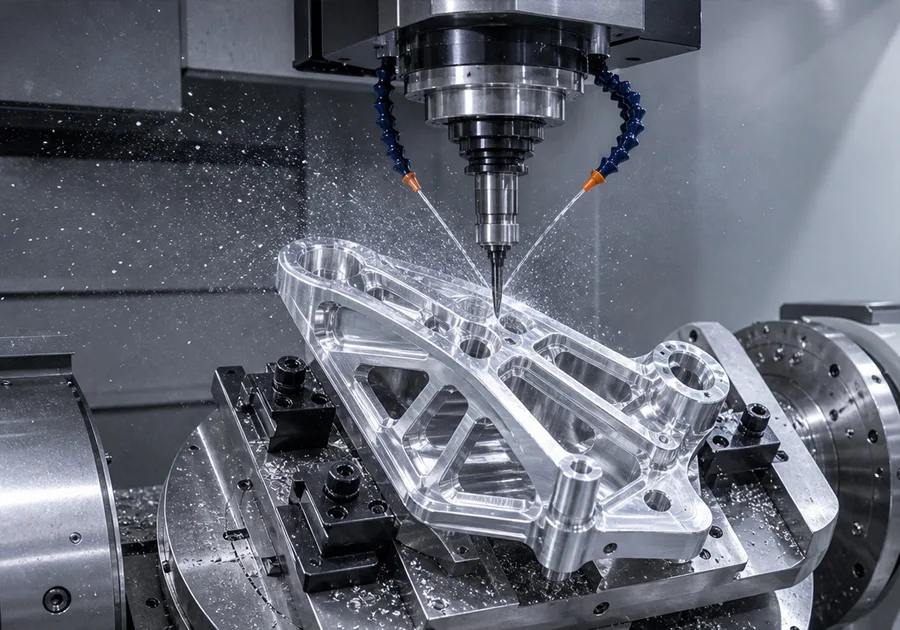
FlexiTurn provides 5-axis CNC machining services alongside 3- and 4-axis milling and turning. This article draws on our experience machining complex parts for aerospace, medical, automotive, robotics and industrial equipment customers.
Understanding Axes in CNC Machining
To understand five-axis machining, it helps to start with the basics. A CNC machine moves the cutting tool and the workpiece relative to each other along axes of motion. The number of axes determines how the tool can approach the part.
Three-axis machining moves the tool along the X, Y and Z axes - left-right, front-back and up-down. The workpiece is typically fixed to a table, and the tool approaches from one direction (usually from above). Three-axis machining is the most common and most economical form of CNC milling. It is suitable for parts with features accessible from a single direction, such as plates, brackets, housings and simple molds.
Four-axis machining adds a fourth axis, usually rotation of the workpiece around the X or Y axis (A or B axis). This allows the part to be rotated so that features on multiple faces can be machined without re-fixturing. Four-axis machining is common for cylindrical parts, shafts and parts with features on several sides.
Five-axis machining adds a fifth axis, typically rotation around the other horizontal axis (C axis) or a tilting spindle. The combination of two rotational axes and three linear axes allows the tool to approach the workpiece from almost any angle. This enables machining of complex contours, undercuts, deep pockets, angled holes and sculpted surfaces in a single setup.
There are two common five-axis machine configurations: table-table (both rotational axes are in the table) and spindle-tilt (one or both rotational axes are in the spindle head). Each has advantages for different part sizes and geometries. The important point for buyers is that five-axis capability allows complex parts to be machined accurately and efficiently.
What Five-Axis Machining Enables
Five-axis machining enables several capabilities that are difficult or impossible on three-axis machines.
Complex contours and sculpted surfaces. Five-axis machining can follow curved surfaces with the tool always perpendicular to the surface, producing smooth finishes and accurate contours. This is valuable for molds, impellers, turbine blades, medical implants and aerodynamic components.
Undercuts and back features. A three-axis machine cannot reach features that are hidden behind other features. A five-axis machine can tilt the tool to reach undercuts, back bores, side holes and internal features.
Multi-face machining in one setup. Instead of re-fixturing the part for each face, a five-axis machine can rotate the part and machine multiple faces in a single setup. This improves accuracy (because re-fixturing introduces error) and reduces setup time.
Angled holes and features. Five-axis machining can drill and mill angled holes and features without special fixtures. This is valuable for parts with complex hole patterns.
Better surface finish and tool life. By keeping the tool at an optimal angle to the surface, five-axis machining can improve surface finish and reduce tool wear. This is especially important for hard materials such as titanium and stainless steel.
Reduced need for EDM and other processes. Some parts that would require electrical discharge machining (EDM) on a three-axis workflow can be machined directly on a five-axis machine, reducing cost and lead time.
These capabilities make five-axis machining attractive for complex, high-value parts. But they also come with higher machine cost, programming complexity and inspection requirements.
When Five-Axis Machining Is Worth It
Five-axis machining is worth considering when one or more of the following conditions apply.
The part has complex 3D geometry. Sculpted surfaces, organic shapes, deep contours and compound angles are difficult or impossible to machine accurately on a three-axis machine. If the part looks like it was designed in a 3D modeling program with freeform surfaces, five-axis machining may be necessary.
The part has undercuts or back features. If the tool cannot reach a feature from the top, a five-axis machine may be the only way to machine it without special fixtures or EDM.
The part requires machining on multiple faces with tight tolerances. Re-fixturing a part on a three-axis machine introduces positioning error. If the tolerances between features on different faces are tight, five-axis machining in a single setup can improve accuracy.
The part is large or heavy. For large parts, re-fixturing can be difficult and time-consuming. Five-axis machining can reduce handling and setup time.
The part is made from a difficult material. For titanium, stainless steel and other hard materials, five-axis machining can improve tool life and surface finish by keeping the tool at an optimal angle.
The part is high-value and low-quantity. For complex, high-value parts, the cost of five-axis machining may be justified by improved quality, reduced setup time and fewer operations.
The part is part of a critical assembly. If the part must fit precisely with other components, the accuracy of five-axis machining can reduce assembly problems.
On the other hand, five-axis machining may not be worth it for simple parts with features accessible from one direction, loose tolerances, low quantities or cost-sensitive applications. In these cases, three-axis machining is usually faster and cheaper.
How Five-Axis Machining Affects Cost
Five-axis machining has a reputation for being expensive, and it can be. But the relationship between five-axis capability and cost is more nuanced than it appears. In some cases, five-axis machining can actually reduce total cost.
Higher machine rate. Five-axis machines cost more to purchase, maintain and operate than three-axis machines. The hourly rate for five-axis machining is therefore higher. This is the most visible cost factor.
Reduced number of setups. Five-axis machining can machine multiple faces in a single setup, eliminating the time and cost of re-fixturing. For complex parts, this can offset the higher machine rate.
Reduced fixture cost. Complex parts often require custom fixtures for three-axis machining. Five-axis machining can reduce or eliminate the need for special fixtures, saving tooling cost and lead time.
Improved accuracy and reduced scrap. Machining in a single setup improves accuracy and reduces the risk of scrap. For high-value parts, this can be a significant cost saving.
Better surface finish and reduced finishing. Five-axis machining can produce better surface finishes, reducing the need for manual polishing or secondary operations.
Fewer operations and shorter lead time. By combining operations, five-axis machining can shorten the production cycle and reduce lead time.
The net effect depends on the part. For a simple part, five-axis machining is more expensive. For a complex part with multiple faces and tight tolerances, five-axis machining can be competitive or even cheaper than a multi-setup three-axis workflow.
When requesting a quote, ask the supplier whether the part will be machined on a three-, four- or five-axis machine and why. A good supplier will explain the trade-offs and recommend the most cost-effective approach.
Design Considerations for Five-Axis Machining
Designing for five-axis machining is different from designing for three-axis machining. A few considerations can improve results and reduce cost.
Avoid unnecessarily complex geometry. Complex geometry increases programming and machining time. If a simpler shape meets the functional requirements, it may be cheaper to machine.
Consider tool accessibility. Even a five-axis machine has limits. Very deep pockets, narrow slots and internal features may still be difficult to reach. Design with tool access in mind.
Specify tolerances realistically. Five-axis machining can hold tight tolerances, but tight tolerances increase cost. Specify tight tolerances only where functionally necessary.
Consider surface finish requirements. Five-axis machining can produce good surface finishes, but very fine finishes may require additional polishing. Specify the functional surface finish and cosmetic requirements separately.
Plan for inspection. Complex five-axis parts may require CMM inspection or other advanced measurement. Design with inspection access in mind.
Provide complete CAD data. Five-axis programming requires accurate 3D models. Provide STEP or native CAD files with clean geometry.
Discuss DFM with the supplier. A supplier with five-axis experience can suggest design changes that improve machinability, reduce cost or improve quality.
AstraRoll-style collaboration between design and manufacturing is especially valuable for five-axis parts. Early DFM feedback can prevent costly design changes later.
Five-Axis Machining vs. Other Processes
Five-axis machining is not the only way to produce complex parts. It competes with other processes such as three-axis machining with multiple setups, EDM, casting and additive manufacturing.
Three-axis machining with multiple setups is suitable for parts that can be fixtured accurately on multiple faces. It is cheaper per hour but requires more setup time and may introduce positioning error.
EDM can machine features that are difficult to reach with a rotating tool, such as sharp internal corners and deep narrow slots. It is slower than machining and is usually used for specific features rather than entire parts.
Casting is suitable for complex shapes in high volumes. It requires tooling and has longer lead times for prototyping.
Additive manufacturing (3D printing) can produce complex internal features and lightweight structures. It is often used for prototypes and low-volume parts, and it can complement five-axis machining for hybrid manufacturing.
The right process depends on the part geometry, material, quantity, tolerance and surface finish requirements. A supplier with multi-process capability can recommend the best approach.
Choosing a Five-Axis Machining Supplier
Not all suppliers who claim five-axis capability are equal. When evaluating a supplier, ask the following questions.
What machines do they operate? Ask about the number of five-axis machines, the configuration (table-table or spindle-tilt), the work envelope and the spindle power. This tells you whether they can handle your part size and material.
What is their programming capability? Five-axis programming requires CAM software and skilled programmers. Ask about their CAM systems and programming experience.
What is their inspection capability? Five-axis parts often require CMM inspection or advanced measurement. Ask about their inspection equipment and whether they provide inspection reports.
What is their experience with your industry? Five-axis machining is common in aerospace, medical, automotive and robotics. A supplier with experience in your industry will understand the quality and documentation requirements.
Can they provide DFM feedback? A good five-axis supplier will review your design and suggest improvements before production.
Do they offer surface treatment and assembly? Many five-axis parts require finishing and assembly. A supplier who offers these services can simplify your supply chain.
What are their lead times? Five-axis machining can take longer than three-axis machining, especially for complex parts. Ask for realistic lead times and confirm them in the order.
FlexiTurn provides 5-axis CNC machining services with advanced equipment, experienced programmers and rigorous inspection. We work with customers to optimize designs for five-axis machining and deliver precision parts from prototype to production.
Common Applications of Five-Axis Machining
Five-axis machining is used across many industries. Common applications include:
- Aerospace: turbine blades, impellers, structural components, engine parts and complex brackets.
- Medical: implants, surgical instruments, prosthetics and diagnostic equipment components.
- Automotive: engine components, transmission parts, prototyping and motorsport parts.
- Robotics: end effectors, joints, frames and custom components.
- Industrial equipment: molds, dies, pump components, valves and complex housings.
- Energy: turbine components, heat exchangers and specialized fittings.
In each case, the value of five-axis machining comes from the ability to machine complex geometry accurately, efficiently and in fewer setups.
Five-axis CNC machining is a powerful capability for complex parts. It enables sculpted surfaces, undercuts, multi-face machining and angled features that are difficult or impossible on three-axis machines. It can improve accuracy, reduce setups and shorten lead time. But it also costs more per hour and requires careful design and programming.
The decision to use five-axis machining should be based on the part geometry, tolerances, material, quantity and total cost - not on the assumption that more axes are always better. For complex, high-value parts, five-axis machining is often the best choice. For simple parts, three-axis machining is usually faster and cheaper.
If you are unsure whether your part needs five-axis machining, ask a supplier with multi-axis capability to review your design. A good supplier will recommend the most cost-effective approach and explain the trade-offs.
FlexiTurn provides 5-axis CNC machining services alongside 3- and 4-axis milling and turning. Contact us with your CAD files and requirements to discuss your project and get an accurate quote.
- 5-Axis CNC Machining Service: When Do You Need It?
- How to Get an Accurate Online CNC Machining Quote
- Breaking New Ground in High-Precision CNC Machining
- CNC Machining in the Electronics Industry
- Why Are Deep Cavities Difficult to CNC Machine?
- What Causes Dimensional Variation in CNC Machined Parts?
- CNC Machining Tolerances: What Accuracy Does Your Part Really Need?
- Why Do CNC Machining Quotes Differ Between Suppliers?